Industry myths that harm sugar gliders
Marketing claims and misinformation that cause real harm. Know these before you buy, adopt, or take advice from a pet store.
Myth: A lone sugar glider will bond more closely with its owner
The claim: Some sellers promote the idea that a single sugar glider will bond more closely to a human, or that gliders can live happily alone as long as they get enough attention at night.
The reality: Sugar gliders are colony animals — they evolved to live in groups of 10 to 15 individuals. A glider kept without a bonded companion is at high risk for chronic stress, depression, self-mutilation, and a shortened lifespan. Human interaction, no matter how attentive, cannot replicate having a companion present 24 hours a day who communicates in the same language. A bonded pair is the minimum ethical setup.
See also: Can sugar gliders live alone, or do they need a companion? · What is Self-Mutilation Syndrome (SMS)?
Myth: Sugar gliders are low-maintenance pocket pets
The claim: Sugar gliders are marketed as low-effort, pocket-sized novelty animals — easy starter pets comparable to hamsters or mice, requiring minimal cage space and care.
The reality: Sugar gliders are complex exotic marsupials with a 12–15 year lifespan. They require a fresh, nutritionally calculated diet prepared weekly, a large vertical cage, a bonded companion, nightly interaction during their active hours (which begin at sunset), specialized exotic veterinary care, and a warm, stable environment maintained year-round. They crab, bark, and run a wheel at 3:00 AM. The "pocket pet" label is a marketing classification, not a care description.
See also: Are sugar gliders high-maintenance pets? · How much does it cost to keep sugar gliders?
Myth: Commercial pellets are a complete diet for sugar gliders
The claim: Many pet stores sell branded sugar glider kibble or pellets as a complete, all-in-one diet — sometimes actively discouraging fresh food as messy or unnecessary.
The reality: Commercial pellets alone are nutritionally insufficient and are associated with chronic deficiencies, liver disease, and urinary tract problems. Sugar gliders require a calculated staple diet — BML, TPG Fresh, AWD, or HSG — combined with fresh fruits, vegetables, and protein. Products from Exotic Nutrition (ZooPro), Kaytee, Vitakraft, and Pocket Pets (Pouch Mates) are specifically flagged by the community as linked to poor long-term health outcomes when used as a primary diet.
See also: Which commercial diet brands should I avoid? · What is BML diet and why is it so popular?
Myth: Weaning age and lineage tracking don't matter
The claim: Some sellers release joeys before they are fully weaned, or dismiss lineage documentation as unnecessary paperwork that buyers shouldn't worry about.
The reality: Joeys must remain with their colony until fully weaned and developmentally mature. Animals pulled too early suffer immune deficiencies, developmental problems, and behavioral issues that persist for life. Lineage tracking prevents inbreeding — a serious problem in captive sugar glider populations that causes genetic health complications across generations. A seller who dismisses both is telling you something important about how they operate.
See also: How do I find an ethical source for sugar gliders?
Myth: Heat rocks are safe, and "lifetime health guarantees" mean something
The claim: Some sellers bundle unregulated heat rocks with starter kits, or offer conditional "lifetime health guarantees" as a sign of confidence in their animals.
The reality: Heat rocks pose serious burn and fire hazards — they are not a safe heat source for any small animal. Sugar gliders need ambient temperature maintained between 75–80°F using a room space heater or ceramic heat emitter, not a contact heat source. "Lifetime guarantees" typically void coverage the moment you deviate from the seller's exclusive product line. They are a sales mechanism, not a health commitment. Real long-term health comes from proper diet, a documented genetic background, and an established exotic vet relationship.
Myth: Sugar gliders are nocturnal but make no noise at night
The claim: Some sellers downplay the nocturnal nature of sugar gliders, assuring buyers that gliders are quiet at night or sleep right through the dark hours without disturbing the household.
The reality: Sugar gliders are strictly nocturnal and intensely active after sunset. Far from being silent, a pair will produce a variety of sounds throughout the night — energetic wheel running, pouch rustling, climbing, sharp barking, and crabbing. Volume varies by individual and setup, but expecting silence from active nocturnal marsupials sets up unrealistic expectations that often lead to disrupted sleep and frustrated owners who weren't prepared for what they signed up for.
Myth: Sugar gliders have small teeth and don't really bite
The claim: Some sellers downplay defensive instincts by claiming that because gliders are small, their teeth are too tiny to do any real damage — or that they simply don't bite humans.
The reality: Sugar gliders possess sharp, specialized incisors designed for gouging tree bark to harvest sap, backed by strong jaw muscles for their body size. A well-bonded glider rarely bites aggressively, but a frightened, defensive, or improperly handled glider can and will bite — and those teeth break skin. Respecting their boundaries, learning to read their body language (crabbing, freezing, lunging), and letting trust build at their pace is how bites are prevented — not by assuming their size makes them harmless.
Myth: You should not handle a new sugar glider for a full month
The claim: Some advice suggests completely ignoring a new sugar glider and avoiding all handling or pouch time for an entire month to let them adjust on their own.
The reality: Leaving them undisturbed for the first 24–48 hours is correct and important. But waiting a full month to interact can actively work against bonding. Sugar gliders need consistent, low-pressure exposure to your scent, voice, and presence during their first weeks home — typically by wearing them in a bonding pouch during the day and hand-feeding treats in the evening. Complete avoidance for a month causes them to remain fearful and semi-feral, delaying trust rather than building it. The goal is balance: respect their sleep, don't force handling, but stay actively present in their daily routine.
See also: How do I start bonding with a new sugar glider? · How long does bonding take?
Myth: Young joeys only need pellets, vitamin powder, and a fruit slice until they're older
The claim: Some breeders suggest that growing joeys can be raised on a simplified diet of commercial pellets, a dusting of vitamin powder, and a single piece of fruit daily — transitioning to a full diet only after they reach adulthood.
The reality: Growing joeys have intensive nutritional requirements. Their developing bones, organs, and tissues need a complete, scientifically balanced staple diet — BML, TPG Fresh, or AWD — with proper calcium ratios, varied fresh vegetables, and quality protein from the start. Feeding a deficient, oversimplified diet to a developing marsupial causes severe problems: metabolic bone disease, organ deficiencies, and developmental damage that cannot be corrected later. Cutting nutritional corners during the growth phase causes permanent harm.
See also: Why does the Ca:P ratio matter so much? · My sugar glider is dragging its back legs — what should I do?
Myth: Any standard vet can treat a sugar glider
The claim: Some sellers and pet stores suggest that if your sugar glider ever gets sick, you can take them to your local neighborhood cat-and-dog veterinarian for care.
The reality: Sugar gliders are exotic marsupials with unique physiology, very small body weights, specialized metabolisms, and distinct medical needs. Standard small-animal veterinarians typically receive little to no training in marsupial medicine, anesthesia protocols, or pharmacology. Taking a glider to an inexperienced vet can lead to misdiagnosis, improper medication dosing, or unsafe anesthesia — any of which can be fatal in an animal this small.
You must identify and establish care with a qualified exotic veterinarian who explicitly treats sugar gliders before an emergency happens — not during one. Ask specifically how many sugar gliders the vet sees regularly, not just whether they "see exotics." Find one before you bring your glider home.
See also: How do I find a specialized vet for my sugar glider? · Do I need a vet visit right away? · SuggieHub vet map
Myth: Sugar gliders have no smell if you feed them the right food
The claim: Some sellers claim their gliders are odor-free because of a proprietary diet, implying that any smell in your enclosure is the result of feeding them the wrong food — specifically, not the seller's branded product.
The reality: Sugar gliders have a natural scent as a biological fact. Intact males have prominent scent glands on the forehead and chest used for territorial marking, and these produce a distinct musky odor regardless of diet. Neutering significantly reduces — but does not eliminate — scent. Regular cage cleaning manages the rest. No food product can override an animal's natural biology.
Tying "no smell" to an exclusive commercial diet is a deliberate sales loop: it convinces buyers that any odor is their own fault for straying from the brand, which drives them back to purchasing expensive proprietary pellets and supplements indefinitely. It's a retention mechanism dressed up as a care claim.
See also: Do sugar gliders smell?
Myth: A bonded sugar glider doesn't really need a cage
The sales pitch: Once a glider is bonded to you, they can safely live loose or free-roam in a bedroom like a ferret or cat, without a dedicated enclosure.
The reality: Sugar gliders are tiny, hyper-curious nocturnal marsupials with a natural drive to explore every crevice, chew on electrical wires, slip behind drywall, and squeeze into spaces they can't get back out of. An uncontained glider unsupervised overnight is at serious risk of being crushed, electrocuted, poisoned, or lost permanently. A secure, appropriately sized vertical enclosure is non-negotiable for their safety any time you are asleep or away.
See also: How do I glider-proof a room for free-roaming? · What minimum cage size does a pair of sugar gliders need?
Myth: You can put any group of sugar gliders together and they'll form a happy colony
The sales pitch: Because sugar gliders are colony animals, you can buy an arbitrary group of unrelated, un-neutered gliders from different sources, put them all in a cage on day one, and they will instantly and peacefully bond.
The reality: Sugar gliders are intensely territorial. Introducing unfamiliar gliders without a slow, careful process — scent swapping, neutral-space meetings, and gradual supervised cohabitation — can result in severe territorial aggression, bloody fights, and serious injury. Colony animals bond within a social structure they trust. They do not automatically accept strangers.
See also: How do I introduce a new sugar glider to my existing one? · What does "balling up" mean? · Should I get a male or female sugar glider?
Myth: "Rare color morphs" justify dramatically higher prices
The sales pitch: Labeling standard-colored or lightly tinted joeys as ultra-rare "designer morphs" — using exaggerated or invented color names — to command inflated prices while downplaying any genetic inbreeding risk.
The reality: True recessive color mutations do exist in captive sugar glider populations — leucistic, white face, and mosaic are real and documented. But unethical brokers routinely mislabel standard grey gliders or inflate prices based on minor natural coat variation that has no genetic basis. More critically, breeding carelessly for rare colors without tracking clean lineage produces hidden genetic health problems that surface later in life. A verified pedigree and sound health history matter infinitely more than a marketing color name.
See also: How do I find an ethical source for sugar gliders?
Myth: "Hand-fed" joeys arrive pre-bonded and need no trust-building
The sales pitch: Because the breeder hand-fed or bottle-fed the joey from day one, it comes pre-bonded, requires zero work, and will instantly love anyone the moment it arrives home.
The reality: Early handling by a reputable breeder helps socialization, but sugar gliders bond to individuals based on scent, voice, and consistent daily routine — not to humans in general. A joey shipped to a new home will still experience fear, will still need time to decompress, and will often crab and defensive-bite until trust is built the normal way. Expecting a glider to arrive "pre-bonded" sets up disappointment for night one and can lead owners to give up on bonding work they mistakenly believe shouldn't be necessary.
See also: How do I start bonding with a new sugar glider? · How long does bonding take?
What to expect when you get a sugar glider
Your starting point for sugar glider care — how to care for a sugar glider before and after they come home. Still researching? Start at the top — big-picture questions first. Already brought them home? Jump to the First Night Home section below.
Are sugar gliders high-maintenance pets?
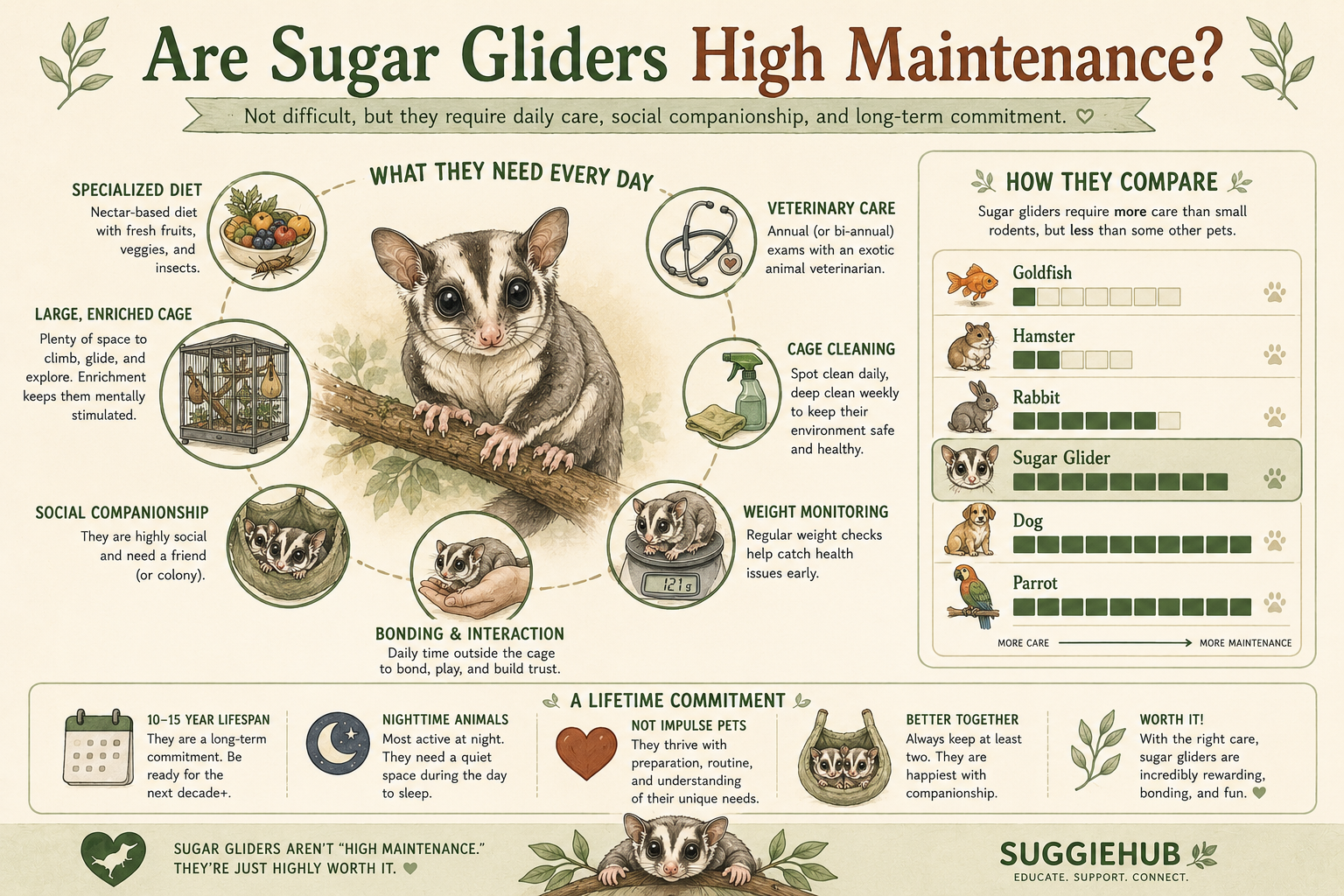
Yes — honestly. Sugar gliders require a specialized fresh diet prepared at least weekly, a minimum of two animals for social health, an exotic vet familiar with marsupials, and meaningful nightly interaction since they are nocturnal animals that need both enrichment and bonding time. They live 12 to 15 years. The commitment is real and long-term.
That said, "high-maintenance" doesn't mean difficult once you understand the routine. Owners who go in prepared often find glider care becomes second nature. The people who struggle are usually those who didn't know what they were signing up for. This FAQ exists so you know before you decide.
See also: Myth: Sugar gliders are low-maintenance pocket pets
How do I know if a sugar glider is right for me?

Sugar gliders are a good fit if: you're home in the evenings and willing to spend consistent time with them nightly, you can commit to preparing fresh food weekly, you're able to find and afford an exotic vet, you can provide a warm and stable environment, and you're prepared for a 12+ year relationship.
They're not a good fit if: you travel frequently, your schedule is unpredictable, you're looking for a low-effort companion, you live somewhere that can't maintain appropriate temperatures, or you're not prepared to get two.
The owners who love sugar gliders tend to be people who wanted an interactive, bonding-oriented exotic pet and were realistic about what that involves going in. The ones who have a hard time are usually those who expected something more like a hamster. They are genuinely different from any other common pet, and that difference is the point — for the right person.
Note: "Sugar Bears" are not a separate species; it is simply a commercial marketing term used for standard sugar gliders.
Will sugar gliders keep me awake at night?
Potentially, yes — and this is one of the most underestimated parts of glider ownership. Sugar gliders are nocturnal. Their active hours begin at sunset and run through the night. You will hear barking, wheel running, pouch rustling, and general cage activity while you're trying to sleep. The volume varies by individual glider and setup, but it can be surprisingly loud for small animals.
Most owners solve this by keeping gliders in a room with the door closed, or using a white noise machine. Many find they adjust to the sounds within a few weeks. It's worth thinking through before you commit — especially if you're a light sleeper or share a bedroom wall with someone who is.
How much does it cost to keep sugar gliders?
Beyond the initial cage setup and cost of the gliders themselves, the main ongoing expenses are fresh food prepared weekly, calcium and vitamin supplements, and exotic vet visits — which typically cost significantly more than standard dog or cat appointments. Emergency exotic vet care for a small marsupial can run several hundred dollars or more. Diagnostics like fecal exams, bloodwork, and X-rays add up quickly.
Budget realistically before committing. The food and supplement costs are modest; the vet costs are where people are most often caught off guard, especially if a glider develops a health issue that requires ongoing treatment.
What are the realistic startup costs for sugar gliders?
The science: Sugar gliders have significant upfront financial requirements that catch many new owners off guard. A realistic baseline budget for a proper initial setup — a safe appropriately-sized enclosure, approved exercise wheels, staple diet ingredients, enrichment, sleeping pouches, supplements, and a basic vet buffer — is roughly $1,000 to $1,500, not including the cost of the gliders themselves. Cutting corners on setup almost always results in higher costs later in the form of vet bills or replacement equipment.
Beyond the setup, budget $50 to $100 per month for fresh diet ingredients and supplements. The larger financial variable is veterinary care — exotic vet appointments cost significantly more than standard dog or cat visits, and diagnostics (fecal exams, bloodwork, X-rays) add up quickly. Maintaining a dedicated emergency fund of at least $500 to $1,000 before bringing any glider home is strongly recommended. An exotic vet emergency is not the time to be figuring out how to pay for it.
With SuggieHub: Keeping health records, diet logs, and vet visit notes in one place means you're never reconstructing history from memory when something unexpected comes up. Your Vet Tools history gives both you and your vet a complete picture from day one.
Can sugar gliders live alone, or do they need a companion?
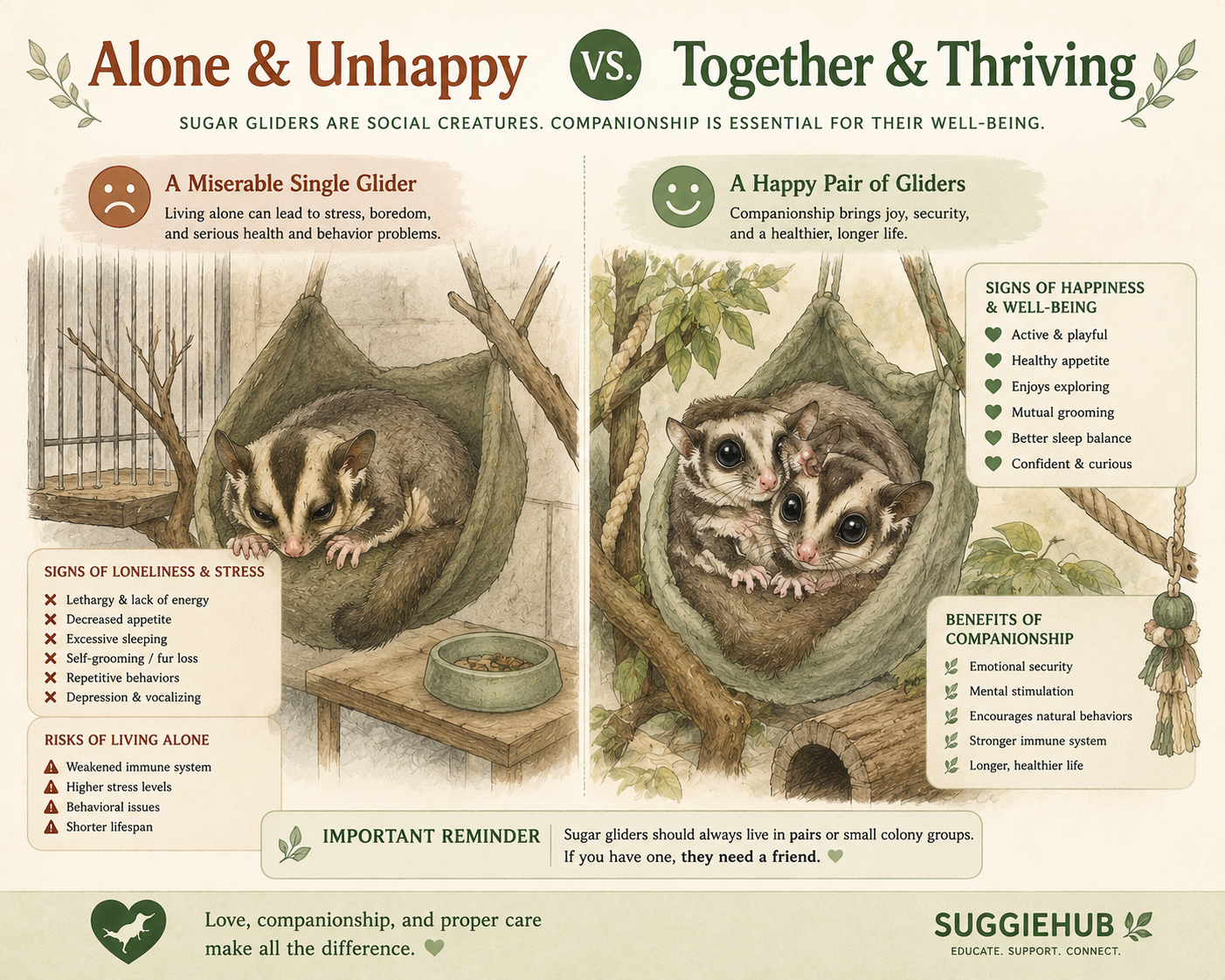
In nearly every case, yes. Sugar gliders are colony animals that evolved to live in groups of 10 to 15 individuals. A lone glider without a bonded companion is at real risk for loneliness-related stress — even with attentive human owners. A human presence a few hours each evening cannot replicate having a companion who is present 24 hours a day and communicates in the same language.
Solo gliders can develop signs of psychological distress: excessive self-grooming that leads to bald patches, increased defensiveness, loss of appetite, and in severe cases self-mutilation. A bonded pair is the standard minimum. Same-sex pairs work well; opposite-sex pairs should be altered to prevent unplanned breeding unless you are intentionally and knowledgeably breeding.
See also: Myth: A lone glider bonds more closely with its owner
Should I get a male or female sugar glider?
In terms of companionship, bonded pairs of both sexes make wonderful pets, but there are distinct biological and behavioral differences to keep in mind:
| Feature | Intact Males | Neutered Males | Females |
|---|---|---|---|
| Scent Glands | Distinct bald spots on head and chest; strong musky odor. | Glands regress post-neuter; minimal odor. | No bald spots; very minimal natural scent. |
| Behavior | Can exhibit territorial marking or occasional dominance. | Generally calm, sweet, and easy to bond with. | Can have minor hormonal mood swings during estrus cycles. |
| Anatomy | Pendulous scrotum visible on the abdomen. | Smooth abdomen post-procedure. | Visible pouch slit on the abdomen. |
Note: Intact males should never be housed with females unless you are an educated breeder with documented lineage, as they reproduce quickly. Keeping two intact males together can also lead to severe territorial fighting; neutering eliminates this risk.
See also: Myth: Any group of gliders will form a happy colony
How do I find an ethical source for sugar gliders?
Bringing a glider home is a 12 to 15-year commitment. Finding a reputable source ensures you aren't inadvertently supporting mill brokers.
Red Flags 🚩: Anyone selling extremely young joeys (under 8 weeks out-of-pouch), anyone claiming they can live alone happily, or sellers using marketing gimmicks like "Sugar Bears."
Green Flags ✅: Breeders who track clean, verified lineage databases to prevent inbreeding, rescues that require an application and setup proof, and anyone who asks you detailed questions about your diet plan and exotic vet access.
See also: Myth: Weaning age and lineage tracking don't matter
What do I need to have ready before bringing a sugar glider home?
Have these in place before your glider arrives — not the day after:
Housing: A tall, secure cage (minimum 24×36×36 inches for a pair) with bar spacing no wider than ½ inch — the MidWest Critter Nation Deluxe is the most widely recommended starting cage in the glider community. At least one fleece sleeping pouch. Climbing branches, hanging toys, and a glider-safe exercise wheel with a solid open-face surface and no center axle — the Raptor Wheel and Free Runner are the community's top picks.
Diet: A chosen staple diet prepared and ready — BML, TPG Fresh, AWD, or another documented plan. Fresh fruits and vegetables. Insects for protein. Calcium supplement. Water dish or sipper bottle.
Vet: An exotic vet identified and their number saved before you need it. Schedule a wellness exam within the first week or two of bringing your glider home.
Setup: A quiet, warm location for the cage away from direct sunlight, drafts, and other pets. Room temperature ideally between 75–80°F. A bonding pouch to wear during the day.
Having everything ready reduces stress on both you and your new glider — the first few days matter a lot for how they settle in.
Can I use a harness or leash to take my sugar glider outside?
No, you should never use a harness, collar, or leash on a sugar glider. Because their delicate gliding membrane (the patagium) runs along the sides of their body from wrist to ankle, any restrictive harness or strap can easily tear, bruise, or permanently damage the membrane during movement. If you want to carry your gliders outside the house, use a secure, zippered bonding pouch with breathable mesh panels so they remain safe and contained.
What should I feed my glider on day one?
Find out what they've been eating before they come home and continue feeding the same thing initially — sudden diet changes cause digestive stress, especially in an already-stressed new arrival. Ask the breeder or rescue for their current diet details before pickup day.
Once settled (typically one to two weeks), you can begin transitioning to your chosen staple diet. A balanced sugar glider diet includes a nectar-based staple (BML, TPG Fresh, AWD, or similar), fresh fruit, fresh vegetables, and protein sources such as insects, cooked chicken, or eggs. Fresh water must always be available.
Pick one documented staple diet and follow it consistently — each plan is carefully calculated as a nutritional system, and mixing two throws off the ratios both were designed around. A calcium supplement is standard with virtually every diet plan and should be part of your setup from the start.
My new glider is making a terrifying buzzing noise — is that normal?
The science: Yes, completely normal. That loud, harsh, mechanical buzzing or rasping sound is called crabbing. It is a defensive vocalization biologically designed to sound like a much larger, threatening predator — an instinct that evolved to scare off danger in the wild. When you first bring gliders home, everything is unfamiliar: new smells, new sounds, and a giant human hand reaching toward them. Crabbing is how they say "I'm scared and I want you to back off." It does not mean they hate you, that something is wrong with them, or that bonding is hopeless. They simply don't know you yet.
The right response is to stay calm, move slowly, and give them space. Don't try to push through the crabbing by forcing interaction — that makes it worse. Let them settle on their own time.
With SuggieHub: Use the Milestone Journal to note how often they crab during your first evening interactions. Over the coming weeks, you'll see that frequency drop as trust builds — and looking back at those early entries is one of the most rewarding parts of the bonding journey.
Should I try to hold my gliders on their first night home?
The science: No — as tempting as it is, leave them completely alone for the first 24 to 48 hours. Moving into a new environment causes significant biological stress even in a healthy, well-socialized glider. Forcing your hands into their cage or trying to pull them out to cuddle will trigger their fight-or-flight response and teach them that your hands mean stress — an association that can take weeks to undo.
Focus on passive bonding for the first couple of days. Let them sleep undisturbed during the day. In the evening, change their food and water quietly, speak in a low calm voice, and let them observe you without pressure. Sitting near the cage and reading or watching something is genuinely useful — they learn your scent and the rhythm of your breathing, and start to associate your presence with calm rather than alarm.
With SuggieHub: Use the Glider Profile to note each glider's initial temperament on day one — "very defensive," "timid," "curious despite crabbing." This gives you a clear baseline to look back on a month from now when things feel completely different.
My glider escaped the cage — how do I catch them safely?
The science: A loose sugar glider — especially a brand-new arrival who doesn't know you yet — can squeeze behind furniture, into appliances, or through surprisingly small gaps. Chasing them, throwing blankets, or cornering them triggers severe panic — they'll run faster and may bite hard in self-defense. The instinct to chase is the worst thing you can do.
Instead: close all doors to contain them to one room, turn off the main lights, and go quiet. Take their favorite sleeping pouch, drop a high-value treat inside (a small piece of mealworm or a tiny drop of honey works well), and hold it open near where you think they're hiding. Their natural drive to find a safe, familiar-scented space will almost always draw them in on their own — often within minutes.
If they're completely out of sight and not responding, leave the pouch on the floor in the room, turn off all lights, and check back in 20–30 minutes. A glider that feels unthreatened will eventually come to their pouch.
With SuggieHub: Keep the Caregiver page updated with the location of your "escape kit" pouches so anyone watching your home knows exactly what to do and where to find them — including pet sitters who may have never dealt with a loose glider before.
How long does bonding take and what should I expect?
Bonding timelines vary enormously — from a few weeks to several months depending on the individual glider's personality, their background, and how consistently you work with them. There is no shortcut, and pushing too hard too fast backfires every time.
What to expect in the early days: your glider will likely crab (a loud rasping sound) when approached, retreat into their pouch, and seem completely uninterested in you. This is completely normal. They're not broken, and you haven't done anything wrong. They don't know you yet.
The most effective bonding techniques are: carrying them in a bonding pouch worn close to your body during the day so they habituate to your scent and voice; hand-feeding small high-value treats in the evening; speaking softly and moving slowly; and giving them the choice of whether to approach rather than forcing contact. Never chase or corner a glider to pick them up — it sets the relationship back significantly.
Progress tends to feel invisible and then arrive suddenly. Many owners describe a point where something just clicks — the glider stops crabbing, starts climbing onto them voluntarily, and the whole dynamic shifts. That moment is worth the patience it takes to get there.
See also: Myth: Hand-fed joeys arrive pre-bonded
Is it okay to wake my sugar gliders up during the day to play?
The science: Sugar gliders are strictly nocturnal animals. Their circadian rhythms, eye structure, and hormone levels are built around sleeping when the sun is up. Repeatedly pulling them out of their pouch during the day disrupts their natural sleep cycle and causes chronic biological stress — which weakens the immune system and can lead to behavioral changes like sudden biting, defensive aggression, or overgrooming. Daytime contact should be passive only: carrying them in a bonding pouch while they sleep against your body is fine and actually excellent for bonding. Waking them up to play is not.
With SuggieHub: Use the Milestone Journal to note when your gliders naturally wake up on their own in the evenings. Tracking their natural schedule helps you plan out-of-cage time for when they're alert and ready to engage — not groggy and stressed from being disturbed mid-sleep.
Do I need a vet visit right away?
Yes — schedule a wellness exam with an exotic vet within the first week or two of bringing your glider home. This establishes their baseline health, catches any issues that arrived with them (parasites, nutritional deficiencies, injuries), and most importantly builds a relationship with a vet before an emergency forces the issue.
Finding an exotic vet who has real experience with sugar gliders takes research — not every exotic practice knows marsupials well. Ask in the sugar glider community for recommendations in your area, and call ahead to confirm their experience before booking. You want this figured out before you need it urgently at midnight. Search the SuggieHub vet map for exotic vets in your area.
Bring a fresh stool sample (collected within 24 hours), a written list of your glider's current diet, and any health records from the breeder or rescue they came from.
How do I find a specialized vet for my sugar glider?
Standard small-animal veterinarians (who primarily treat dogs and cats) generally do not have the specialized training or diagnostic equipment required to treat marsupials. You must locate a dedicated exotic veterinarian.
Where to Search: Start with the Association of Exotic Mammal Veterinarians (AEMV) locator tool, or use the SuggieHub exotic vet map to find vets in your area who treat sugar gliders.
What to Ask: When you call a potential clinic, don't just ask if they "see exotics." Ask specifically: "Which veterinarian on staff treats sugar gliders, and how many do they see regularly?"
The Vet Buffer: Always establish a relationship with a wellness check before an emergency occurs.
What does daily care actually look like?
A typical day with sugar gliders looks roughly like this:
Daytime: Your gliders sleep. They need quiet. You leave them alone except to quietly check that fresh water is available and nothing has gone wrong overnight. Carrying them in a bonding pouch while you go about your day is optional but highly effective for building trust during the bonding phase.
Evening: Around sunset your gliders wake up. This is when you interact with them — handle them, let them out for supervised free-roaming in a secured room, offer their nightly food. Fresh food should be put out in the evening when they're active, not sitting out all day. Most owners spend 30 minutes to an hour in active evening interaction.
Weekly: Prepare a fresh batch of staple diet. Deep clean the cage. Do weigh-ins. Check sleeping pouches and toys for wear.
It's not constant work — but it is consistent work. The evening routine especially is non-negotiable.
What are the most common mistakes new owners make?
Getting one glider instead of two. The loneliness risk is real and serious. Start with a pair.
Waking them during the day. Disrupting a sleeping glider repeatedly causes chronic stress. They sleep during the day — leave them to it.
Feeding store-bought pellets as a primary diet. Pellets alone cause nutritional deficiencies that lead to serious illness. A documented staple diet is not optional.
Skipping the calcium supplement. Metabolic bone disease is one of the most common preventable health problems in captive gliders. Calcium supplementation is part of every established diet plan for a reason.
Forcing bonding. Chasing, cornering, or forcing handling during the early weeks teaches gliders that humans mean stress. Patient, low-pressure contact every day builds a better relationship faster in the long run.
Not having an exotic vet lined up. Finding a vet for the first time during an emergency is a bad experience. Find one before you need one.
Underestimating the long-term commitment. Sugar gliders live 12 to 15 years. That's a serious time horizon — not a starter pet.
What do I do if I accidentally cut the quick during a nail trim?
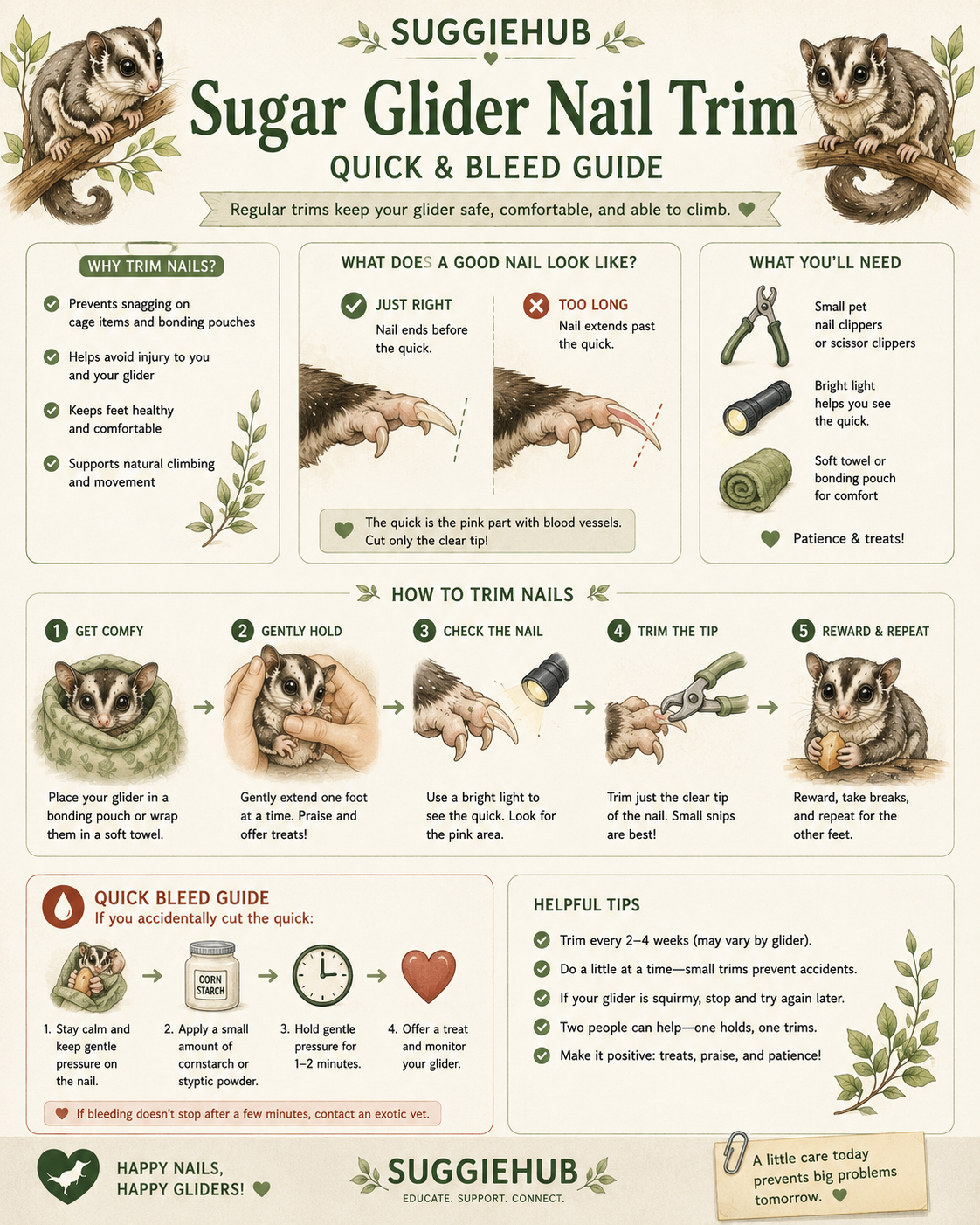
The science: Clipping a nail too short on a small, squirming glider is one of the most common new-owner accidents, and it looks much worse than it is. Sugar gliders have a small blood volume, so stopping the bleeding quickly matters — but the tool you reach for matters too. Press plain cornstarch or flour firmly against the tip of the nail for 30 to 60 seconds. This forms an immediate, safe clot. Do not use styptic powder products made for dogs or cats (like Kwik Stop) — they contain chemicals that are too harsh for glider skin and cause burns if licked off.
Once bleeding stops, watch the toe for the next hour to make sure clotting holds. If bleeding restarts or the glider is favoring the foot, contact your exotic vet.
With SuggieHub: Log the incident as an observation note in the Health Tracker. The days-since-trim counter will reset automatically, giving you a natural reminder for when to try again — and the logged note means you have a record if the toe shows any sign of infection at the next trim.
Do sugar gliders bite, and how do I prevent it?
The short answer is yes, sugar gliders can bite — but context is everything. Understanding why they are biting is the key to preventing it, as gliders rarely bite out of malicious aggression.
There are three main reasons sugar gliders bite:
- Fear and Self-Defense: A new or untamed glider treats a large human hand like a predator. If they are cornered, poked, or forced out of their pouch before they trust you, they will bite hard to protect themselves. This is often accompanied by a loud buzzing noise called crabbing.
- Exploration and Tasting: Gliders navigate their world using their scent and their teeth. A gentle, curious nip or scrape is often just them investigating a new smell on your skin (like soap, lotion, or residual food oils).
- Grooming: In an established colony, gliders scrape and nibble each other's fur to clean it. If they trust you, they may try to "groom" your hands or fingers. While intended as a sign of affection, their sharp teeth can sometimes pinch.
How to Prevent and Manage Biting:
If a glider bites out of fear, do not pull your hand away quickly or make a loud noise. Pulling away rewards the bite by teaching the glider that biting successfully scares the "giant predator" away. Instead, hold your hand still, speak calmly, and gently blow a short puff of air at their face to interrupt the behavior.
Always wash your hands with unscented soap before handling them to remove appealing food odors, and respect their boundaries during the daytime when they are trying to sleep.
See also: Myth: Sugar gliders have small teeth and don't really bite
Can sugar gliders be potty trained or housebroken?
Will sugar gliders get along with my dog or cat?
Can you be allergic to sugar gliders?
Yes, though it is rarely an allergy to their fur itself.
The True Triggers: Most human reactions are triggered by the proteins in their saliva or urine, or the dust from their diet/supplements.
The "Scratch" Reaction: Because gliders have sharp nails for climbing, their tiny scratches can transfer trace amounts of urine into your skin. This often causes localized red, itchy welts on your arms or neck. Washing your hands and arms with unscented soap immediately after handling usually resolves this.
New to sugar gliders and want hands-on guidance from someone who has been there? The Sugar Glider Groupies Facebook group offers free mentorship programs where experienced owners work one-on-one with beginners — covering diet, bonding, health, and everything in between. It's one of the most genuinely helpful communities in the glider world.
For lineage research, pedigree tracking, and colony genetics, Sugar Glider Guardians maintains community databases that breeders and rescues rely on. If you're ever trying to trace where a glider came from or document offspring responsibly, that's the place to start.
Understanding your glider's biology
Weird but normal — the questions owners ask out of curiosity rather than emergency.
How do sugar gliders actually glide?
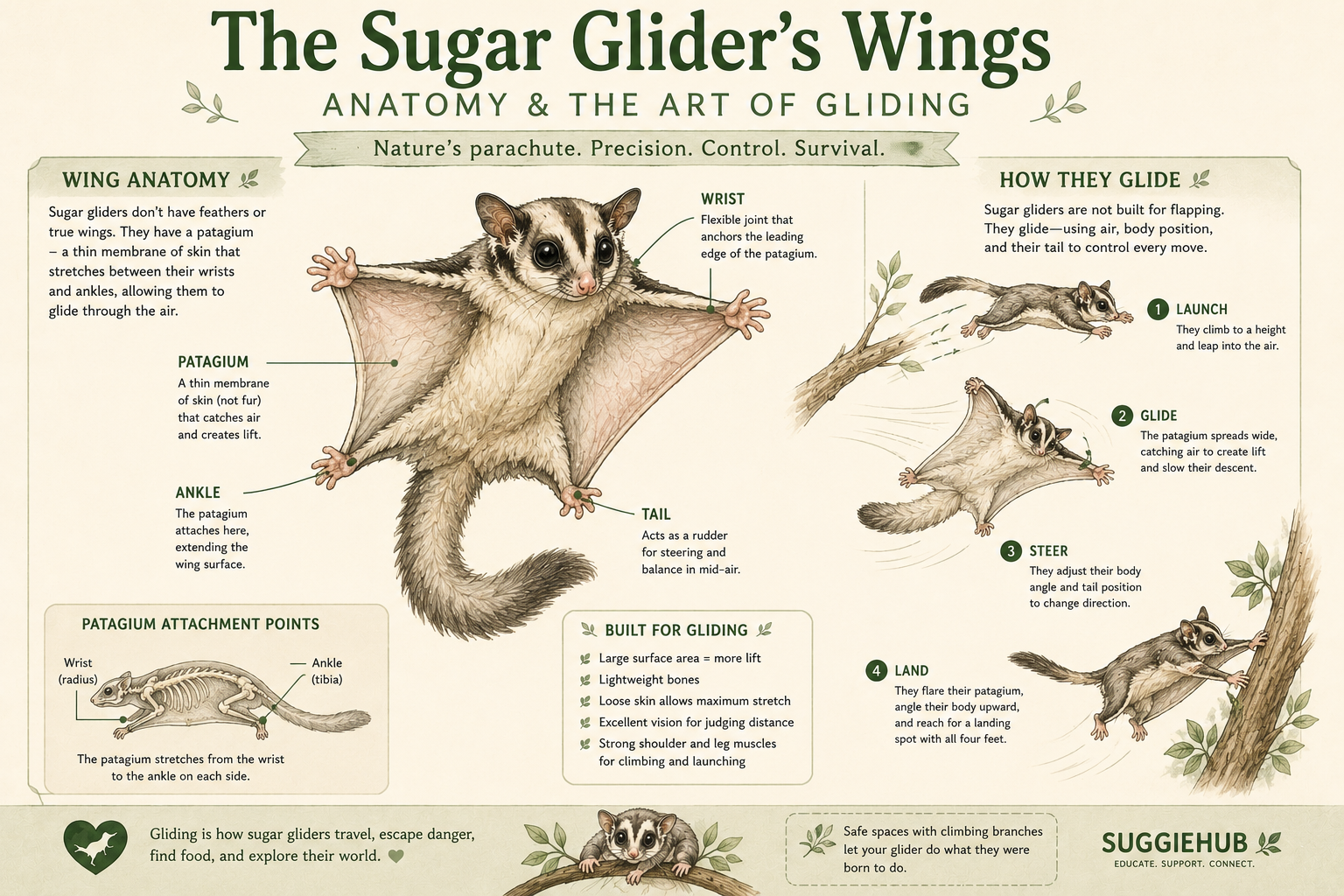
The science: Sugar gliders don't fly — they glide using a specialized membrane called the patagium that stretches from their wrists to their ankles. When they leap and spread their limbs, the patagium opens like a cape and allows them to glide long distances. In the wild, a single glide can cover over 150 feet. They steer by adjusting the tension of each side of the membrane independently.
With SuggieHub: The patagium is a thin, delicate skin membrane vulnerable to tears if it catches on rough cage surfaces or unsafe equipment. Use the photo documentation feature in the Glider Profile to keep clear reference photos so small injuries are easy to spot before they become infected.
Why is my sugar glider spitting on its hands and grooming itself?
The science: This is called spit-grooming, and it's completely normal. Sugar gliders produce a specialized saliva they spread over their fur to keep it clean and to maintain their colony scent. A glider that spit-grooms regularly is a healthy, self-aware animal. It can also be a social behavior — gliders in a bonded pair will groom each other.
With SuggieHub: If a glider stops self-grooming and the fur looks cracked, oily, or separated, that's an early sign of illness or significant stress. Log "changes in grooming habits" in the Health Journal with the date you first noticed it — your vet will use that timeline to determine how long the animal has been feeling unwell.
Do sugar gliders need baths or dust baths?
No, sugar gliders are self-cleaning animals and should never be given water or dust baths. Like cats, they spend significant time spit-grooming their incredibly dense fur using their partially fused grooming toes (the syndactylous digits on their hind feet). Getting a sugar glider wet can cause severe stress and lead to rapid hypothermia, while dust baths can severely irritate their prominent, protruding eyes.
Can sugar gliders see in the dark?
The science: Sugar gliders are nocturnal and have very large eyes relative to their body size to capture as much available light as possible. However, they cannot see in complete darkness — they rely heavily on their whiskers (vibrissae) and an acute sense of smell to navigate at night. Their prominent eyes make them highly sensitive to sudden bright light, which is why being taken out in a brightly lit room during the day can startle them.
With SuggieHub: Because their eyes are so prominent, sugar gliders are prone to Fatty Eye (lipid corneal opacities) if their diet is consistently too high in fat. Use the Diet Shopping List to stick to a balanced staple diet and treat high-fat foods like mealworms as occasional enrichment rather than daily staples.
Why does my sugar glider make a loud rasping noise?
The science: That sound is called crabbing. It's a defensive vocalization sugar gliders make when startled, annoyed, or afraid — biologically designed to mimic a larger, more threatening predator to scare off danger. New gliders and untamed gliders crab most frequently. It can sound alarming but it means the glider is communicating, not that you've done something wrong.
With SuggieHub: Use the Milestone Journal to log how often your glider crabs during bonding sessions. Over weeks and months you'll see the frequency drop as trust builds — watching that arc in the log is one of the most rewarding parts of the bonding process.
Why does my sugar glider bark like a small dog at night?
The science: Barking is a normal social call. A glider may bark to locate colony members, alert the group to an unfamiliar noise, or simply seek attention. It's most common at night when they're active. Occasional barking is healthy and normal.
With SuggieHub: Excessive or frantic barking can indicate stress, loneliness, or something wrong in their environment. Log barking patterns in the Milestone Journal — if you notice barking correlates with nights you skipped a bonding session or changed something in their cage, you have a concrete pattern to work from rather than a vague sense that something's off.
Normal male sugar glider anatomy: bald spots and scent glands
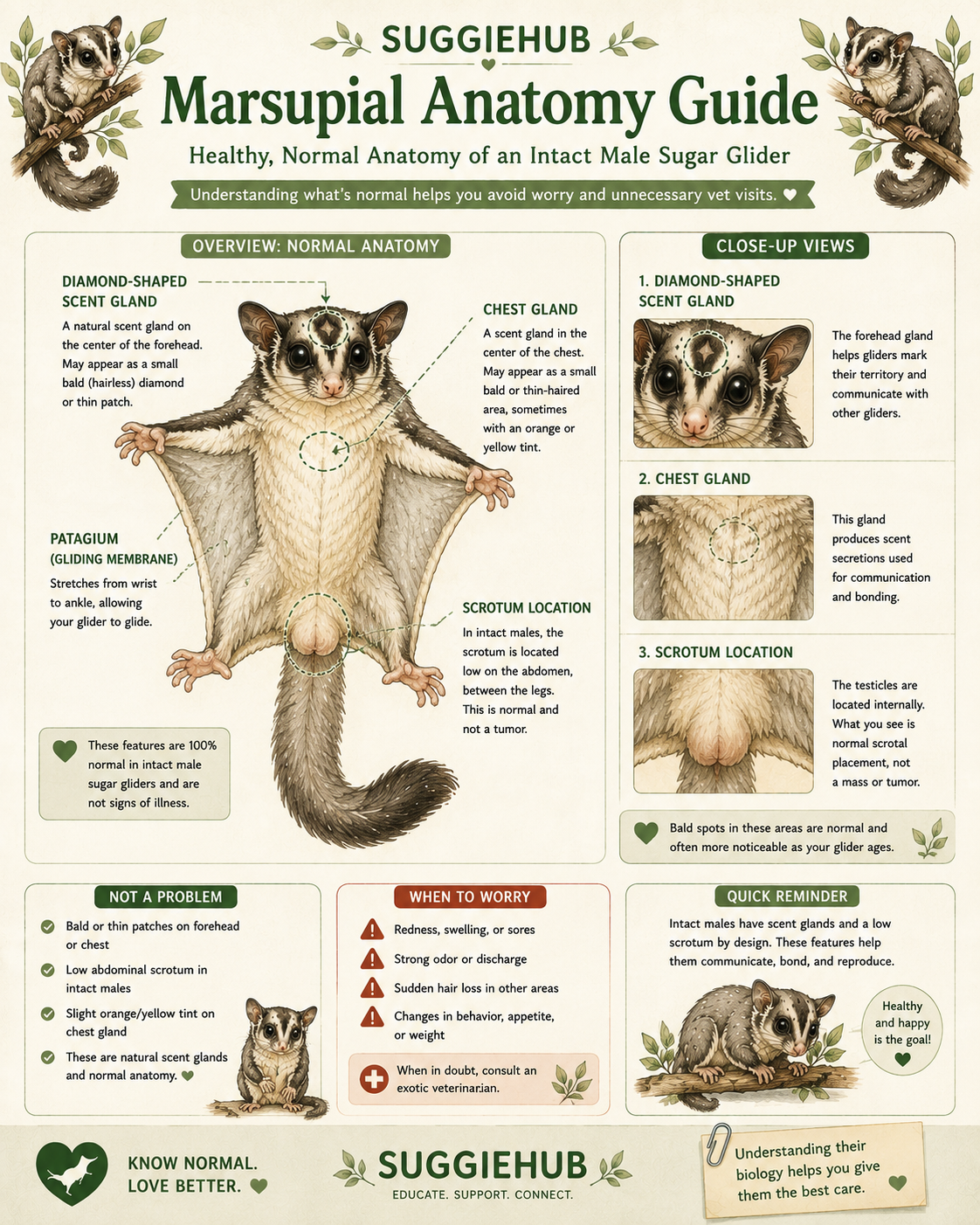
The science: Male sugar gliders have a bifid (forked) penis, and their scrotum is located on the lower abdomen rather than between the legs — an anatomical layout that frequently alarms new owners who mistake the scrotum for a tumor, a lump, or a strange belly button. This is completely normal anatomy. Intact males also have prominent bald spots on their head and chest from scent glands, which is equally normal and not a skin condition.
With SuggieHub: Knowing your glider's normal anatomy is the foundation of catching when something is actually wrong. In the Glider Profile, you can record whether your male is intact or neutered — which matters for tracking hormonal behaviors like scent marking, aggression, and the size and visibility of the bald spot over time.
Why does my sugar glider seem wobbly or "drunk" when it first wakes up?
The science: This is called sleep inertia — commonly known among glider owners as "the dizzies." Sugar gliders have high metabolisms and very deep sleep cycles, so their bodies need several minutes to fully reboot after waking. Wobbliness, stumbling, or apparent disorientation for 5–10 minutes right after waking is completely normal and not a cause for concern.
With SuggieHub: Persistent wobbliness lasting longer than 10–15 minutes, or wobbling during their fully active hours, is a different matter — it can signal dehydration, MBD, or a neurological issue. Log how quickly your glider "comes online" after waking in the Health Journal. If the pattern changes, you have a timeline to share with your vet.
What do the different sounds my sugar glider makes mean?
Sugar gliders are surprisingly vocal. Learning to read their sounds helps you understand how they're feeling:
- Crabbing — a loud, harsh rasping or buzzing sound, like a large locust. A defensive alarm call made when startled, scared, or annoyed. Very common in new or untamed gliders. As trust builds, crabbing becomes less frequent. It's them communicating, not misbehaving.
- Barking — sounds like a small dog or puppy. A social call used to locate colony mates, alert to unfamiliar sounds, or seek attention. Normal and healthy. Excessive or frantic barking during odd hours can indicate stress, loneliness, or something wrong in the environment.
- Chirping — soft, bird-like sounds. Usually indicates contentment or communication between bonded colony mates. A positive sign.
- Hissing — a quieter, lower version of crabbing. Mild irritation rather than full alarm — the equivalent of "back off a little."
- Sneezing — completely normal. Gliders sneeze to clear their noses, often during or after grooming. Occasional sneezing is fine. Repeated sneezing paired with discharge, wheezing, or clicking breath sounds is a sign to contact a vet.
- Soft clicking or purring — some gliders make quiet content sounds while being held or groomed by a colony mate. Considered a sign of comfort and trust.
With SuggieHub: Log changes in vocalization patterns in the Milestone Journal. A glider that suddenly starts barking much more, or stops chirping with a bonded companion, may be telling you something has changed.
My sugar glider makes a clicking sound when it breathes — is that normal?
No. A clicking, crackling, or wet-sounding noise with each breath — distinct from normal chirping or vocalizing — is a potential sign of a respiratory infection or fluid in the lungs. It is not a sound to monitor and wait on. Contact an exotic vet promptly if you hear breathing that sounds labored, wet, or clicking with each cycle. Sugar gliders can deteriorate quickly when respiratory function is compromised.
What does my sugar glider's body language mean?
Reading body language helps you understand how your glider is feeling and track bonding progress over time:
- Freezing flat against a surface — fear response. They feel exposed and are trying to be invisible. Give them space and reduce stimulation.
- Lunging toward you — usually a startle or warning. Back your hand away and approach again more slowly.
- Grooming you — a significant trust milestone. They're treating you as a colony member and participating in a core social behavior.
- Sleeping on or against you — deep trust. Choosing to sleep in your presence or on your body means they feel genuinely safe with you.
- Voluntarily gliding to you — they've chosen you as a safe landing target. One of the clearest bonding milestones there is.
- Turning their back to you — mild disinterest or slight discomfort. Not alarming, but they'd prefer a bit more space right now.
- Actively seeking your pouch or shirt pocket — they're comfortable enough to look for warmth and security from you. A strong positive sign in the bonding process.
- Puffing up fur and swaying — agitation or defensive display, often before crabbing. Give space.
Sugar glider facts
Quick, accurate facts about sugar gliders — biology, behavior, and what makes them unique among exotic pets.
What is the scientific name for a sugar glider?
Are sugar gliders marsupials?
How far can a sugar glider glide?
How fast can a sugar glider run?
What do sugar gliders eat in the wild?
How many sugar gliders live in a wild colony?
What is the patagium?
Are sugar gliders nocturnal?
Where are sugar gliders native to?
How do sugar gliders reproduce?
Where they come from — and what's not true
Common myths about sugar gliders spread fast on social media and in big-box pet stores. These answers address the misinformation head-on with science.
Where do sugar gliders come from?
The science: Sugar gliders (Petaurus notatus, commonly classified as Petaurus breviceps, meaning "short-headed rope-dancer") are native to the rainforests of Australia, Indonesia, and Papua New Guinea. They are arboreal marsupials — tree-dwelling mammals that carry undeveloped young in a pouch — and in the wild they live in large family colonies in hollowed-out eucalyptus trees. They evolved their gliding membranes to travel quickly between trees while avoiding ground predators.
With SuggieHub: Because they evolved in tight social colonies, the Colony Management dashboard is built to reflect that reality — tracking the entire group together so no individual glider gets overlooked in a busy colony.
Can sugar gliders really live in my pocket?
The myth: Gliders are "low-maintenance pocket pets" that can spend most of their time in a hoodie pouch.
The reality: While gliders enjoy bonding pouches for short periods, they are high-intelligence, highly active animals. They need a large flight cage, mental enrichment, nightly free-roam time, and a bonded companion. Treating them as a passive "living toy" causes chronic stress and serious health problems.
With SuggieHub: The Milestone Journal includes an enrichment log to track cage rotations and new toys — ensuring the mental stimulation these intelligent animals genuinely need.
Are sugar gliders quiet pets?
The myth: Small animal = quiet animal.
The reality: Gliders are remarkably vocal. From barking (social calls) to crabbing (defense) and sneezing (a normal grooming sound), they produce a surprising range of loud sounds — often at 3:00 AM during their peak activity hours.
With SuggieHub: Use Daily Notes to track vocalization patterns. A sudden increase in nighttime barking can indicate boredom or stress — and having a logged baseline makes it easier to spot when something has changed.
Why are commercial sugar glider pellets bad for their diet?
The myth: Big-box pet stores sell "Sugar Glider Pellets" marketed as a complete diet.
The reality: Pellets alone are dangerously insufficient. Sugar gliders require a complex staple diet (like BML, TPG Fresh, or AWD) combined with fresh vegetables, fruits, and proteins to prevent Metabolic Bone Disease and organ failure. Pellets should be treated as a supplement at most — not a foundation.
With SuggieHub: The Diet Shopping List is built to help owners move past the pellet myth. Select a proven staple diet and the system generates a shopping list for the actual fresh ingredients your gliders need.
Short answers to common questions
The questions people ask Siri, Google, and Alexa about sugar gliders.
Can sugar gliders eat grapes?
Grapes and raisins are best left out of a sugar glider's diet, but the reason why is often misunderstood — and it matters.
The dog connection: Grapes and raisins are well established to cause acute, irreversible kidney failure in dogs. Even a small amount — a handful of grapes or a single raisin — can trigger it in some dogs, and the reaction can be fatal within days. The exact mechanism isn't fully understood, but tartaric acid (found in grapes) is the current leading theory. Symptoms in dogs typically appear within 6–12 hours: vomiting, lethargy, loss of appetite, and eventually signs of kidney failure. It is one of the most serious food toxicity risks in dogs, which is why the warning is so widely circulated in pet care circles.
Why this gets conflated with sugar gliders: Because the dog warning is so prominent, it tends to get applied broadly to all pets. Many sugar glider care lists copied it without sourcing the original research, which was specific to canines. That's how "grapes are toxic to gliders" entered circulation.
For sugar gliders specifically: Grapes are excluded from the diet primarily because of their very high natural sugar content. A glider's small body doesn't need that sugar load, and regularly offering high-sugar fruits — especially ones with no meaningful protein, fiber, or calcium — contributes to obesity and dental decay over time. They aren't a useful part of a balanced glider diet. Better fruit choices include blueberries, papaya, mango, and apple (seeds removed).
Other foods to always avoid: chocolate, onions, garlic, caffeine, alcohol, avocado, fruit seeds and pits, and anything with artificial sweeteners. Log your glider's safe foods in the Caregiver page so anyone watching them knows what not to feed.
Do sugar gliders need vaccines?
How long do sugar gliders live?
Are sugar gliders legal to own?
Before adopting, it is crucial to verify your local laws, as penalties can result in confiscation. As a baseline, sugar gliders are strictly illegal to keep as pets in:
- California
- Hawaii
- Alaska
- The five boroughs of New York City
Various specific counties and municipalities nationwide may also have restrictions (e.g., parts of Pennsylvania require specific permits). Always check both state wildlife laws and local city ordinances before planning a setup.
Do sugar gliders smell?
See also: Myth: Sugar gliders have no smell if you feed them the right food
How big do adult sugar gliders get?
What sugar gliders can and can't eat
One of the most searched topics for glider owners. When in doubt, check here first — and log diet changes in the Health Journal so you have a record if a problem shows up later.
What fruits can sugar gliders eat?
Sugar gliders enjoy a wide variety of fruits. Safe options include apples (seeds removed), blueberries, strawberries, raspberries, blackberries, bananas, pears (seeds removed), papaya, mango, watermelon, cantaloupe, honeydew, peaches and apricots (pit removed), kiwi, figs, and dates.
Always wash fruit thoroughly before offering. Remove any seeds or pits — many contain cyanogenic compounds that are harmful to small animals. Fruit should be part of a balanced diet, not the majority of it, since excess sugar contributes to obesity and dental decay over time.
Never feed: Grapes and raisins. They are well known to cause acute, irreversible kidney failure in dogs — that warning is dog-specific, but grapes are still excluded from a glider's diet because of their very high sugar content and lack of nutritional value. The sugar load contributes to obesity and dental decay without offering anything a glider actually needs. Citrus fruits in large amounts cause digestive upset in many gliders and are best avoided or offered only sparingly.
What vegetables can sugar gliders eat?
Safe vegetables include carrots, sweet potatoes, green beans, peas, corn, bell peppers (any color), cucumber, zucchini, squash, snap peas, and broccoli in small amounts. Fresh or properly thawed frozen vegetables both work well.
Avoid: Onions, garlic, leeks, and chives are toxic alliums and should never be offered. Iceberg lettuce has essentially no nutritional value. Spinach in large or frequent amounts contains oxalates that can interfere with calcium absorption — a significant concern given how prone sugar gliders are to calcium deficiency. Raw potato is also best avoided.
What protein sources are safe?
Safe protein sources: Mealworms, crickets, and dubia roaches (live or dried) are excellent options that closely mirror what gliders eat in the wild. Hard-boiled eggs or scrambled eggs with no added salt or fat. Cooked chicken or turkey — plain, unseasoned, no skin. Plain cooked shrimp in small amounts.
Avoid: Raw meat and raw eggs carry bacterial contamination risk. Processed meats, deli meats, and anything with heavy seasoning, salt, or additives. High-fat protein sources in excess — mealworms in particular are high in fat and phosphorus, which can throw off calcium balance and contribute to obesity and Fatty Eye when fed too frequently. Treat insects as enrichment and a protein supplement, not a dietary staple.
Can sugar gliders eat yogurt, eggs, or honey?
Yogurt: Plain, unsweetened yogurt is used in several established diet plans including BML. It provides protein and calcium. Avoid flavored, sweetened, or artificially sweetened varieties.
Eggs: Hard-boiled or scrambled eggs with no added salt, butter, or oil are a safe protein source. Used in several diet plans.
Honey: Used in small amounts in BML and some other diet plans. Fine in the quantities those recipes call for — not as a free-fed sweet treat.
What foods are toxic or dangerous to sugar gliders?
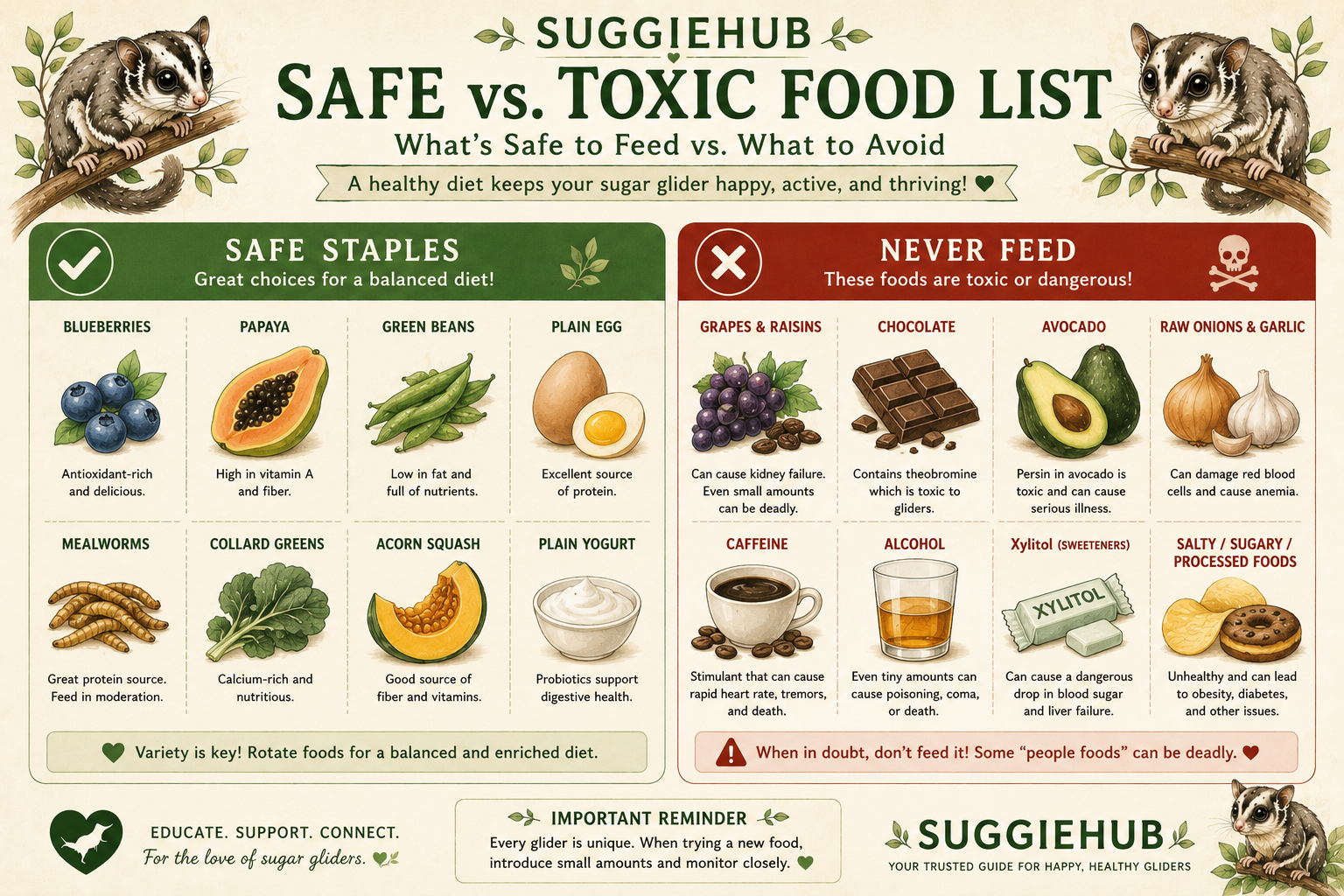
These should never be offered under any circumstances:
- Grapes and raisins — known to cause acute, irreversible kidney failure in dogs; excluded from glider diets due to very high sugar content and no meaningful nutritional value
- Chocolate — contains theobromine, toxic to many small animals
- Caffeine — coffee, tea, energy drinks, soda
- Alcohol — in any amount
- Onions, garlic, leeks, chives — allium family, toxic
- Avocado — toxic to many animals
- Fruit seeds and pits — contain cyanogenic compounds
- Artificial sweeteners — xylitol especially is dangerous
- Raw meat and raw eggs — bacterial contamination risk
- Processed or heavily salted foods — sodium overload
When in doubt, leave it out. A glider's small body size means even modest amounts of a harmful substance can have serious effects quickly.
Can sugar gliders eat peanut butter or nuts?
Peanut butter is best avoided. It's very high in fat and often contains added salt, sugar, and oils that aren't appropriate for gliders. Some peanut butter also carries aflatoxin risk from mold contamination. The fat and phosphorus content can also contribute to calcium imbalance over time.
Most nuts are similarly high in fat and phosphorus and should be offered only very occasionally if at all — not as regular treats. Pine nuts, almonds, and walnuts are sometimes offered in tiny amounts by experienced owners, but they're not necessary and the risks from overdoing high-fat foods aren't worth it.
What do sugar gliders eat? Feeding, diets & the shopping list
Everything on sugar glider nutrition requirements, staple diet recipes (BML, TPG Fresh, AWD), and safe foods. See the full diet & shopping list feature.
What diets are included in the SuggieHub diet library?
What is BML diet and why is it so popular?
The science: Sugar gliders have complex nutritional needs that commercial pellets alone cannot meet. Community-developed staple diets like BML (Bourbon's Modified Leadbeater's) were created to provide a reliable, tested balance of protein, vitamins, and minerals. BML is made from honey, apple juice, yogurt, hard-boiled eggs, a vitamin supplement, and fruit — it freezes well in ice cube trays and is widely accepted by gliders.
With SuggieHub: The Diet Shopping List lets you select BML (or TPG Fresh, AWD, HSG, and others) and automatically generates the full ingredient list so you know exactly what to buy — no transcribing from forum posts or hunting for outdated screenshots.
Why does the Ca:P ratio matter so much for sugar gliders?

The science: To prevent Metabolic Bone Disease (MBD), sugar gliders need a calcium-to-phosphorus ratio of 2:1 or better. Without this balance, the body strips calcium from bones to maintain blood levels — leading over time to tremors, fractures, and paralysis. High-phosphorus foods like corn, certain meats, and some fruits make this imbalance easy to cause accidentally.
With SuggieHub: Logging diet changes in the Health Journal alongside physical observations gives you and your vet a timeline to work with — so if a problem does appear, you have the context to identify what changed and when.
See also: My sugar glider is dragging its back legs — what should I do?
Should I mix multiple staple diets?
Which commercial sugar glider diet brands should I avoid?
The science: Most mass-manufactured pet store kibbles and dry pellet diets marketed for sugar gliders fail to meet their complex nutritional requirements. The glider community has specifically flagged several brands based on documented long-term outcomes: products from Exotic Nutrition (ZooPro), Kaytee, Vitakraft, and Pocket Pets (Pouch Mates) are consistently linked to nutritional deficiencies, chronic dehydration, and liver and urinary tract disease when used as a primary diet.
These products are heavily marketed and widely available in pet stores, which makes them a common choice for new owners who don't yet know to look past the packaging. The community consensus, backed by years of rescue intake data and veterinary observation, is to avoid all of them as a staple food source.
Stick to verified community-developed plans: BML (Bourbon's Modified Leadbeater's), TPG Fresh Diet, AWD (Australian Wildlife Diet), or OHPW. These recipes use fresh grocery ingredients and have been refined and tested over many years.
With SuggieHub: The Diet Shopping List only includes verified community staple plans. Selecting a diet generates a fresh ingredient shopping list — no commercial pellets, no mystery fillers.
Can I feed my glider insects?
See also: What is Fatty Eye (corneal lipidosis)?
Can I add my own items to the shopping list?
Managing cages, groups & cleaning
See the colony management feature and cleaning day tracker.
How do I create a cage group?
Does the per-cage chart show all gliders together?
What cleaning tasks can I track?
Can I set different cleaning schedules for different cages?
Is the colony weigh-in useful for rescues?
What minimum cage size does a pair of sugar gliders need?
The science: A pair of adult sugar gliders needs an enclosure that is at minimum 24 inches wide, 36 inches deep, and 36 inches tall — and larger is always better. Because sugar gliders are climbers and jumpers by nature, vertical height matters more than floor area. A tall cage that lets them leap and glide between levels replicates far more of their natural movement than a wide but short enclosure. Bar spacing should be no wider than ½ inch for adult gliders — larger gaps allow heads or limbs to get trapped.
The most widely recommended starting cage in the glider community is the MidWest Critter Nation Deluxe — it offers ample vertical height, easy-access side and front doors, and bar spacing suited for adult gliders. Connecting two Critter Nation Deluxe units together is a popular community upgrade for owners whose colonies grow.
With SuggieHub: Use the cage name field in the Colony Management tool to track which gliders are housed together. A cage that's too small for a group becomes visible when you can see how many animals are assigned to each enclosure at a glance.
How do I scale cage size for a larger colony?
The science: Sugar gliders don't just climb vertically — they leap and bound horizontally between branches. A cage that meets the minimum dimensions for a pair but lacks width will limit natural movement as the colony grows. A solid baseline for a pair or trio is 4 feet tall by 2 feet wide by 2 feet deep. For each additional glider beyond a pair, add roughly 2×2 feet of floor space to maintain adequate territory and room to move. Crowding gliders in too-small a space increases stress, competition for resources, and colony conflict.
A popular community option for larger colonies is joining two MidWest Critter Nation Deluxe units together — this configuration provides substantial vertical height and enough horizontal space for gliders to genuinely leap between levels rather than just climb.
With SuggieHub: In the Colony Management tool, each cage group shows how many gliders are assigned to it. As your colony grows, that number makes it immediately visible when a cage is reaching the point where an upgrade makes sense.
What bedding is safe for a sugar glider cage?
The science: Recycled paper bedding, aspen shavings, plain paper towels, and shredded paper are all safe choices — absorbent, relatively low-dust, and free of the aromatic compounds that cause problems for small animals. Pine and cedar shavings should be avoided: the natural oils in these woods cause respiratory irritation and are associated with longer-term health problems with regular exposure. Fluffy cotton-fiber bedding products also carry serious risk — they look cozy but break apart into loose strands that can wrap tightly around tiny toes and cut off circulation.
With SuggieHub: Add a recurring "bedding check" or "fleece inspection" task to the Cleaning Day Tracker so liner condition and bedding safety get checked on a schedule rather than only when something looks obviously wrong.
What fabrics are safe for sugar glider pouches and cage liners?
The science: Sugar gliders have microscopic, needle-sharp claws that catch easily on standard fabrics. Cotton, denim, towels, and any woven fabric with loops will fray when chewed or scratched — loose threads wrap around tiny toes and limbs, cutting off circulation or causing accidental amputation. Anti-pill fleece is the only community-approved fabric for sleeping pouches and cage liners. Because it is chemically bonded rather than woven, it does not unravel, fray, or create dangerous loose strings when cut or chewed.
The same entanglement risk applies to rope toys made of sisal, hemp, or cotton. Standard bird or dog rope toys look like enrichment but are a serious hazard. Only offer toys specifically made for sugar gliders, or untreated wooden toys with no loose fiber risk.
With SuggieHub: Add a recurring "Fleece & Pouch Safety Check" to the Cleaning Day Tracker. Run your fingers along the inside seams of every pouch during each wash cycle — hidden wear often isn't visible until you feel it, and catching a fraying seam early is far better than catching it after an injury.
What woods are safe and unsafe for sugar glider cage enrichment?
The science: Fresh branches are excellent enrichment — they encourage climbing, foraging behavior, and natural foot exercise. But the wrong wood can be fatal. Many common trees contain toxic saps, heavy tannins, or volatile aromatic oils that cause respiratory irritation or liver damage in small marsupials.
Never use: Cedar, pine, oak, walnut, or cherry. Cedar and pine release volatile oils that damage airways — the same reason these shavings are unsafe as bedding. Oak tannins and walnut compounds are toxic when chewed repeatedly.
Safe options: Apple, pear, manzanita, and pesticide-free eucalyptus are the most widely used. If sourcing branches yourself, confirm no pesticides have been used on the tree, then wash them thoroughly and bake at 250°F for 30 minutes before introducing to the cage to kill any surface bacteria or insects.
With SuggieHub: Note which branch types and toys your colony interacts with most in the Milestone Journal. Tracking what keeps them climbing and foraging helps you build a safer, more engaging rotation over time.
Why does my cage smell worse the day after a deep clean?
The science: Sugar gliders rely heavily on scent to define their territory and recognize their colony. If you wash the cage bars, scrub the toys, and launder all the fleece pouches in a single session, you completely erase their scent profile. This triggers a stress response — especially in intact males — causing them to go into overdrive re-scenting their home. The result is a noticeably muskier cage within 24 hours than before you cleaned it.
The fix is staggering your cleaning schedule. Wash pouches one week, wipe down the cage structure the next. Rotating one element at a time preserves enough residual colony scent that the gliders don't feel compelled to aggressively re-mark everything at once.
With SuggieHub: The Cleaning Day Tracker supports independent schedules for every task — set "Pouch Laundry" on a separate cycle from "Cage Bar Wipe-down" so the stagger happens automatically. You don't have to remember the timing; the tracker handles it.
Nail trims, stool, tent tests & more
See the full health tracking feature.
How often should I trim my sugar glider's nails?
Can't I just use sandpaper tracks in the wheel?
Why track stool consistency?
What is a tent test?
The science: Bonding with a sugar glider is a slow process of building trust — gliders must learn to see you as a safe zone rather than a threat. A tent test uses a small, enclosed space to create low-pressure contact where the glider sets the pace. Progress can feel imperceptibly slow day to day, which is why many owners give up too soon.
With SuggieHub: Log tent test sessions in the Milestone Journal. Tracking firsts — the first time they take a treat, the first time they climb onto you voluntarily — makes progress visible over weeks and months, and can also surface behavioral changes that may have a health cause rather than a bonding cause.
What does "balling up" mean and why is it a health warning?
See also: Myth: Any group of gliders will form a happy colony
Can I log nail trims for a whole cage at once?
Do seasonal temperature changes affect my glider's health tracking?
What temperature and humidity do sugar gliders need?
The science: Sugar gliders need a stable environment between 75–80°F. Temperatures below 70°F are dangerous and can trigger torpor — an involuntary sleep state the body enters to conserve heat that can be fatal if not caught quickly. Humidity should stay between 45–50%. Too-dry air causes cracked fur and respiratory issues. Avoid placing cages near drafts, air vents, or windows with direct sun exposure.
With SuggieHub: Use the daily notes field in the Health Journal to log your room's ambient temperature on days it seems off. If you later notice a drop in activity or a change in coat quality, you'll have a dated record to correlate against — which your vet will find useful.
See also: What is torpor and why is it dangerous?
Why is my sugar glider's poop watery or discolored?
The science: Stool consistency is a direct window into gut health. Watery, green, or discolored stool can indicate a parasite load (like Giardia), dietary imbalance, stress, or infection. Changes in stool often appear before weight loss or other visible symptoms — making it one of the earliest warning signs available.
With SuggieHub: The stool log in the Health Tracking feature lets you record consistency and color with dates. A week of logged observations is far more useful to your vet than a single stool sample — it shows the pattern, not just a snapshot.
How do I prevent dental problems in sugar gliders?
The science: Dental disease is more common in captive sugar gliders than most new owners expect. Tartar buildup, tooth decay, and oral infections develop when the diet skews too heavily toward soft or sugary foods over time. The natural abrasion of chewing insects — mealworms and crickets especially — helps scrub plaque from teeth in a way that soft staple food alone doesn't replicate. Feeding regular insect protein, keeping sugary treats genuinely minimal, and maintaining a balanced staple diet are the primary ways to support dental health day to day.
Signs of a dental problem include drooling, pawing at the mouth, reluctance to eat hard food, unexplained weight loss, or visible swelling around the jaw or face. If any of these appear, a veterinary dental exam is needed — dental disease in small animals can progress quickly and may require cleaning or extraction under anesthesia if not caught early.
With SuggieHub: Log any changes in eating behavior in the Health Journal with the date you first noticed them. Reduced appetite in a glider that previously ate well is one of the earliest signals of oral discomfort, and a dated record helps your vet understand the timeline.
Can sugar gliders become overweight, and does it matter?
The science: Yes, and it does matter significantly. Obesity in sugar gliders is associated with liver disease, heart problems, reduced activity, and a shortened lifespan. See also: how obesity causes health problems. It typically develops gradually from a diet too heavy in high-fat insects (mealworms in particular), excessive fruit, or frequent sugary treats without sufficient physical activity to compensate. Because the gain accumulates slowly, it's easy to miss until the glider is already well above their healthy weight.
A note worth keeping in mind: healthy body weight varies considerably between individuals. A glider who has always run lighter isn't automatically underweight, and a glider who naturally runs heavier isn't automatically obese. The meaningful signal is a consistent upward trend from an individual glider's own established baseline — not a comparison to population averages.
With SuggieHub: The rolling average and trend chart in the Weight Tracker make gradual weight gain visible long before it becomes a serious problem. Catching a slow upward trend early leaves plenty of time to adjust diet and enrichment before health consequences follow.
Conditions sugar glider owners should know
Sugar gliders are prey animals — they hide illness until it's advanced. Knowing what to look for gives you a real chance of catching problems early. These answers are for reference only; always consult an exotic vet for diagnosis and treatment.
What is a respiratory infection (URI) and how do I spot it?
Upper respiratory infections are among the more common illnesses in captive sugar gliders, often triggered by cold drafts, temperature swings, or exposure to an infected animal. Signs include clicking, crackling, or wheezing sounds with each breath, nasal discharge, lethargy during active hours, loss of appetite, and labored breathing visible as an exaggerated rise and fall of the chest.
Any respiratory symptoms in a sugar glider should be treated as urgent — small animals can deteriorate rapidly when their airways are compromised. Keep the environment warm (75–80°F minimum), eliminate drafts, and contact an exotic vet the same day. Do not wait to see if it improves on its own.
With SuggieHub: Log the date you first noticed symptoms in the Health Journal. Your vet's first question will be "how long has this been going on?" — a dated entry answers that immediately instead of relying on memory.
See also: My sugar glider makes a clicking sound when it breathes — is that normal?
What is torpor and why is it dangerous?
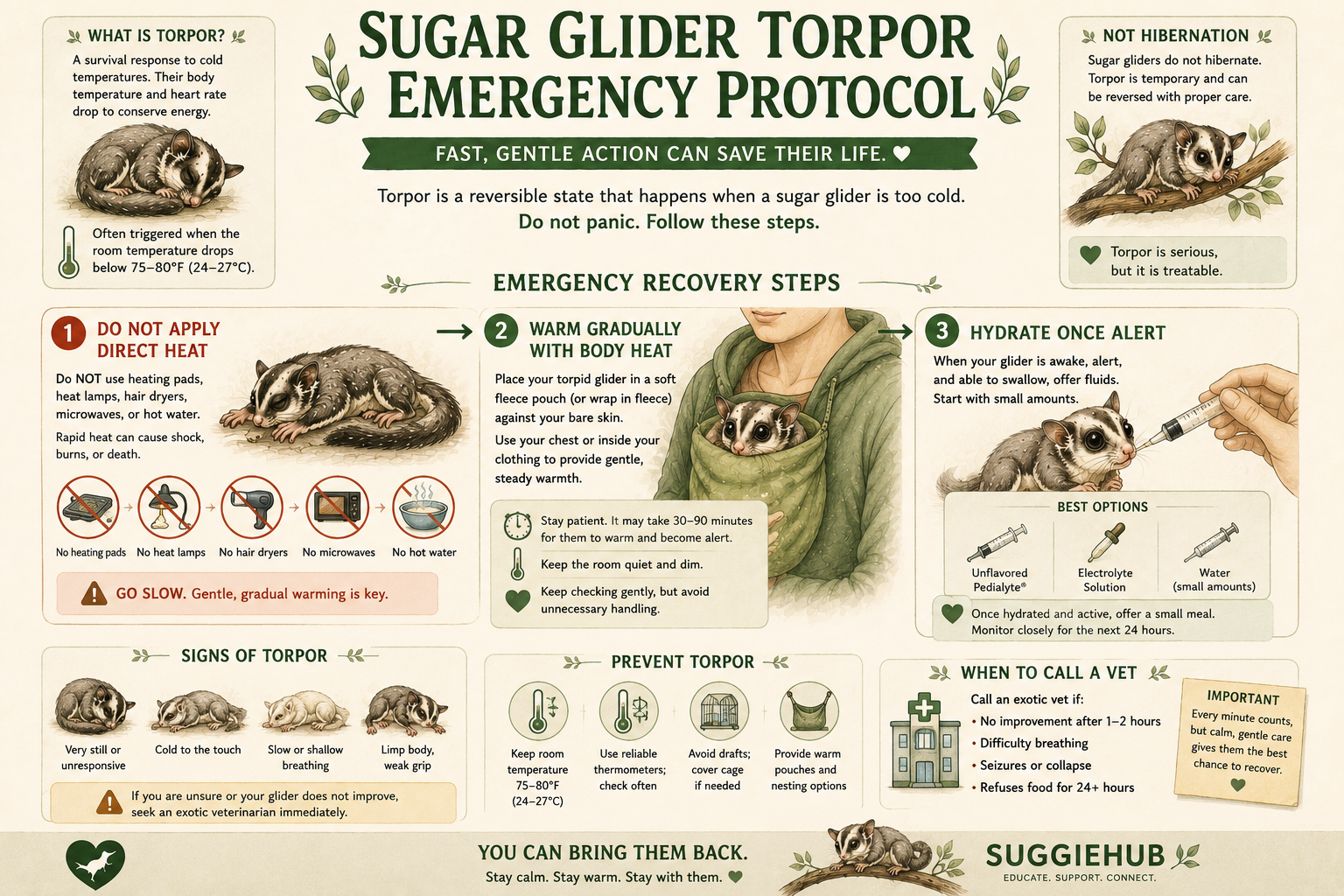
Torpor is an involuntary, emergency sleep state that sugar gliders can fall into when their body temperature drops too low — typically when the environment falls below 65–70°F. Unlike true hibernation, torpor is not a healthy or normal state for captive sugar gliders. It's a stress response, and it can be fatal if the underlying temperature problem isn't corrected quickly.
A glider in torpor will feel cold to the touch, be limp and unresponsive, have very slow or barely detectable breathing, and may appear dead. To respond: hold them against your bare skin to warm them slowly and gently. Do not use a heat lamp or hot water — rapid rewarming causes shock. If they don't regain consciousness and normal movement within 20 to 30 minutes, contact an exotic vet immediately.
Prevention is straightforward: maintain cage temperature between 75–80°F year-round. Keep cages away from air conditioning vents, cold exterior walls, and windows that lose heat at night. If your home gets cold seasonally, a space heater or ceramic heat emitter near (not on) the cage solves the problem.
What is Self-Mutilation Syndrome (SMS)?
SMS is a severe condition where a glider chews or bites at its own body — most commonly the tail, genitals, or limbs. It has two main causes that sometimes overlap: psychological (extreme isolation, loneliness, or chronic stress) and medical (an untreated wound, infection, or source of pain the glider is fixating on).
SMS is very difficult to treat once established. Management typically requires an e-collar to prevent further self-injury, pain medication if there's an underlying medical cause, environmental changes to reduce stress, and in the case of isolation-driven SMS, a bonded companion. Some cases become chronic regardless of intervention.
Prevention is the only practical approach. Never house a glider alone long-term. Address wounds and medical issues promptly — a glider that starts worrying at an injury can escalate to self-mutilation quickly. Ensure adequate enrichment, social contact, and regular handling.
See also: What is an emergency e-collar and why should I have one?
What is Fatty Eye (corneal lipidosis)?
Fatty Eye is a condition where white, opaque, or cloudy deposits develop on the surface of a sugar glider's eye. It's most commonly associated with a diet consistently too high in fat — excess mealworms and other high-fat insects are a frequent contributing factor. It can also have a genetic component in some lines.
Mild cases may stabilize when the diet is corrected to reduce fat intake. Advanced cases can affect vision and require veterinary management. If you notice cloudiness, white patches, or any change in eye appearance, consult an exotic vet and review your glider's diet fat content — particularly insect offerings. Mealworms especially should be treated as an occasional protein boost rather than a daily staple.
What causes hair loss in sugar gliders?
Hair loss in sugar gliders has several possible causes — some normal, some not:
Normal: Intact males naturally develop bald patches on their forehead and chest from scent glands. This is completely normal anatomy and not a skin condition. The size of the bald spot can vary and may change with hormone levels.
Abnormal causes to investigate:
- Overgrooming from stress or boredom — a glider that pulls out its own fur typically has insufficient enrichment, no companion, or an environmental stressor
- Barbering by a cage mate — one glider excessively grooming another, removing fur. Usually indicates a colony dynamic issue
- Nutritional deficiency — poor coat quality and hair loss can result from an imbalanced diet
- Parasites or skin infection — requires veterinary diagnosis and treatment
- Hormonal imbalance — less common but possible
Patchy, spreading, or sudden hair loss that isn't explained by normal scent gland anatomy should be evaluated by a vet. Log when you first noticed it in the Health Journal alongside any other behavioral or dietary changes around the same time.
See also: What is Self-Mutilation Syndrome (SMS)?
What are the signs of Giardia or other parasites?
Giardia is one of the most common parasites found in captive sugar gliders. Signs include persistent loose, watery, or green-tinged stools, gradual weight loss despite a normal appetite, a dull or rough coat, and general poor condition that doesn't improve with dietary changes. Some gliders carry a significant parasite burden for months before showing obvious symptoms.
Diagnosis requires a fecal exam — ideally a float and direct smear — done by an exotic vet. Treatment with metronidazole is generally effective when caught and treated properly. Annual fecal exams are recommended for all sugar gliders as a routine screen, not just when symptoms appear. A new glider being added to a colony should be quarantined and fecal-tested before any contact with existing animals.
See also: Why is my sugar glider's poop watery or discolored?
Can obesity cause health problems in sugar gliders?
Yes. Obesity in sugar gliders is associated with liver disease, heart disease, reduced activity and mobility, and a shortened lifespan. It typically develops gradually from a diet too heavy in high-fat insects, excess fruit, or frequent sugary treats — combined with insufficient physical activity in too-small a cage.
Because weight gain accumulates slowly, it's easy to miss until a glider is already well above a healthy weight. Weekly weigh-ins and a weight trend chart make gradual gain visible months before it becomes a health problem. A glider significantly above their established personal baseline warrants a diet review and, if the trend persists, a vet consultation. See also: how to track weight trends.
See also: Weight concern flags
What is an emergency e-collar and why should I have one?
The science: Standard plastic cone collars made for dogs or cats do not work for sugar gliders. Their flexible bodies allow them to escape most standard cones, and the wrong collar can damage or tear the patagium (gliding membrane). If a glider develops a wound, undergoes surgery such as a neuter, or begins self-mutilating, they require a specialized fleece pom-pom collar or a plastic neck-plate collar sized specifically for small marsupials.
The critical detail: a stressed or injured glider can cause irreversible self-injury in minutes. By the time you realize a collar is needed, ordering one online isn't a realistic option. Having a glider-specific e-collar in a basic first aid kit before any emergency happens is considered essential preparation by experienced owners and rescue coordinators alike.
With SuggieHub: If your glider ever requires an e-collar, use the Medication Tracker to manage their pain relief or treatment schedule closely. Upload photos of a healing wound to the Glider Profile to document daily recovery progress — a visual timeline of how the wound is healing is far more useful to your vet than a verbal estimate of how it looked "a few days ago."
How can I tell if my sugar glider has a urinary tract infection (UTI)?
The clearest early sign is hissing or vocalizing while urinating — and it's worth knowing the difference, because hissing during a bowel movement is completely normal in sugar gliders. Hissing specifically while peeing is not. Other signs include noticeably strong, ammonia-scented urine and reduced interest in food or water. If the entire cage area develops a sudden sharp ammonia smell, suspect a UTI in at least one of your animals.
What to do: A vet visit is needed. UTIs require a course of antibiotics and don't resolve on their own. Most gliders show clear improvement within a few days of starting treatment — if they don't, the antibiotic may need to be switched. Don't wait to see if it gets better; UTIs are straightforward to treat early but can become serious if left alone.
Contributing factors include unsanitary cage conditions and cages with rusty or degraded wire. Some individual gliders are simply more prone to UTIs for reasons that aren't fully understood. The best window to catch problems is when your gliders first wake up in the evening — watch their bathroom habits then and you'll notice anything unusual before it has time to progress.
When something seems wrong
If your glider is in distress, contact an exotic vet immediately. These answers are for reference — they are not a substitute for professional veterinary care.
What are the signs of a sick sugar glider?
The science: Because sugar gliders are prey animals, they hide illness until it's significantly advanced. By the time visible symptoms appear, the condition is often serious. Early warning signs include cracked or separated fur, watery or crusted eyes, lethargy during their active hours, loss of interest in food or high-value treats, and unusual stool. Any of these warrant a prompt call to an exotic vet.
With SuggieHub: Log these physical observations with dates in the Health Journal. An exotic vet's first question in an emergency is always "when did this start?" — a dated record answers that immediately.
My sugar glider is dragging its back legs — what should I do?
The science: Hind leg paralysis or weakness is a classic sign of Metabolic Bone Disease (MBD) caused by calcium deficiency, or a spinal injury. Either is a life-threatening emergency that requires immediate exotic vet care — do not wait to see if it improves.
With SuggieHub: Use the Vet Tools to pull up your vet's contact info quickly, and export your glider's diet and weight history to show the vet exactly what they've been eating and how their weight has been trending. That history is critical for diagnosing MBD.
How do I know if my sugar glider is dehydrated?
The science: Dehydration is a silent and fast-moving emergency for small marsupials. Perform a tent test: gently pinch the skin between the shoulder blades and release. Healthy skin snaps back immediately. If the skin stays tented and doesn't return to normal within a second or two, your glider is likely dehydrated and needs immediate veterinary fluid therapy — do not wait to see if they drink more on their own.
With SuggieHub: The Caregiver page includes a red flag section where you can list the tent test as a priority check. This ensures that even when you aren't home, your sitter knows exactly how to spot this life-threatening symptom and when to call a vet.
Weighing your gliders
See the full weight tracker feature and colony weigh-in tool.
How often should I weigh my sugar glider?
The science: Sugar gliders are prey animals — hiding illness until it's advanced is a survival instinct. By the time a glider looks sick, the problem is often already well progressed. Weekly weighing is the community gold standard for spotting downward trends before any visible symptoms appear.
With SuggieHub: The Weight Tracker is built for weekly entries. Its 4-week rolling average filters out normal daily fluctuation so you only see the meaningful direction the weight is actually heading — not just the noise of whether your glider ate a bigger meal yesterday.
What's a healthy weight for a sugar glider?
The science: Adult females typically range from 75–130g and males from 100–160g, but every glider has a unique personal baseline shaped by genetics, diet, age, and season. A sudden drop from that individual baseline is far more significant than where the number sits on a population chart.
With SuggieHub: Each glider's profile establishes their personal baseline over time. The system monitors for notable changes from that baseline — not a generic population average — so concern flags are meaningful rather than false alarms. Consult an exotic-animal vet if you have specific concerns.
What triggers a concern flag?
How is the rolling average calculated?
Can I log historical weights?
How many gliders can I weigh at once in the colony weigh-in?
What do the color dots mean on the weigh-in page?
Tip: If you see a red flag, weight loss is often the first sign of dehydration. Perform a skin tent test — pinch the skin between the shoulder blades and release. Healthy skin springs back immediately. If it stays tented, your glider may be dehydrated and needs prompt attention.
Can I skip gliders I didn't weigh?
How do I track a joey's growth?
The science: Joeys (out of pouch) should show steady, near-daily weight gain during their first four months. A plateau or drop during weaning is a major concern — a joey not gaining consistently in this window is at high risk for developmental failure and needs prompt vet attention.
With SuggieHub: The Weight Tracker applies stricter concern thresholds for joeys automatically. Log weights frequently during this stage — daily or every few days. The Milestone Journal is also useful for logging weaning behaviors like first time eating solids, which is valuable context to share with a mentor or vet.
Tracking meds & doses
See the full medication tracker feature.
Can I track multiple medications per glider?
The science: When a colony faces an illness like a parasite outbreak, multiple gliders may need different medications at different dosages on strict schedules. Inconsistent dosing — even by a few hours — can lead to treatment failure or resistance, especially with antibiotics like SMZ-TMP where blood level consistency matters.
With SuggieHub: The Medication Tracker manages unlimited active medications per glider, each with its own dosage record, frequency, course length, and live countdown to the next dose. Every glider is tracked separately so nothing gets mixed up.
What if I miss a dose — can I log it late?
Reminder: SuggieHub medication reminders are a helpful aid only. Always maintain your own independent medication schedule — do not rely solely on app notifications to administer medications.
Does SuggieHub send push notifications or text alerts for medications?
Can my vet see the medication log?
Yes — there are two ways to share your glider's full health record with a vet:
Export a health report: You can export a PDF health report for an individual glider or your entire colony. This includes medication history, weight trend chart, vet visit notes, and more — hand it to your vet at the appointment or email it ahead of time.
Share a public glider link: You can set an individual glider's profile to public and share the direct URL. Anyone with that link can view the glider's full record. Nobody else will be able to find or access it — only people you share the link with directly.
How do I add a new medication?
Reproduction, joeys & what to expect
Breeding sugar gliders is a serious commitment that goes well beyond getting a pair together. These answers cover the basics — but responsible breeding requires mentorship, veterinary support, and a realistic plan for offspring before any pairing happens.
How do I know if my sugar glider is pregnant?
Sugar glider gestation is only 16 days, and the birth itself is nearly invisible — the tiny, undeveloped joey crawls from the birth canal to the mother's pouch almost instantly, and you will almost certainly never witness it. Signs that joeys are developing in the pouch include a visible bulge or lump in the pouch area as they grow, the mother eating noticeably more, and spending more time resting in her sleeping area. The pouch area becomes more prominent over the 70–74 day in-pouch development period.
Once joeys emerge from the pouch (called OOP — Out of Pouch), they'll be visible clinging to the mother, initially furless and very small, developing quickly over the following weeks.
How do I care for a glider with joeys in the pouch?
During the in-pouch stage the most important thing you can do is minimize disturbance. Keep the mother's environment calm, warm, and consistent. Make sure she has ample high-quality food — she's providing all nutrition to the developing joey and needs extra calories. Do not attempt to open or examine the pouch to check on the joey. If you're concerned about development, consult an exotic vet rather than investigating manually.
Once the joey is OOP, continue ensuring the mother is eating well. The joey will begin sampling solid foods as they develop. Weigh joeys frequently — daily or every few days — during their first several months. Steady weight gain is the most reliable indicator that development is on track. A plateau or drop in weight during weaning is a serious warning sign that requires prompt veterinary attention.
See also: Joey growth tracking
When do sugar gliders reach sexual maturity?
Females typically reach sexual maturity at 8 to 12 months of age; males at 12 to 15 months. Sugar gliders can breed year-round in captivity without a defined seasonal cycle, which means an opposite-sex pair housed together has the potential to produce joeys continuously. If you're not intentionally breeding, neutering the male is the standard approach for managing an opposite-sex pair. Spaying females is a more complex procedure and is generally not the first recommendation.
What do I need to know before breeding sugar gliders?
Breeding sugar gliders responsibly requires significantly more preparation than simply having a compatible male and female pair:
- Genetics and lineage — understanding the ancestry of both animals to avoid inbreeding, which causes health problems in offspring
- Health screening — both animals should be healthy, at appropriate weight, and free of parasites before any pairing
- Joey care knowledge — knowing how to recognize joey development problems, when to intervene, and how to hand-raise if the mother rejects a joey
- Exotic vet access — complications during birth or joey development can require emergency veterinary care
- Homes for offspring — responsible breeders have homes or a plan for offspring before the joey is born, not after
The sugar glider rescue community receives a substantial number of animals from unprepared breeding situations — owners who "let it happen" without understanding what they were committing to. Breeding should be a deliberate, informed decision, not an accident or an experiment.
How do I track joey growth and know if development is on track?
Joeys should show consistent, near-daily weight gain during their first several months after OOP. The rate slows as they mature, but the direction should always be upward during early development. Weighing daily or every two to three days during the first four months gives you the data you need to catch problems early — a plateau or weight drop during weaning is a major warning sign that can indicate failure to thrive, and early vet intervention dramatically improves outcomes.
With SuggieHub: The Weight Tracker applies stricter concern thresholds for joeys automatically. Log weights frequently during this stage and use the Milestone Journal to note developmental firsts — opening eyes, first solid food, first glide attempt — so you have a complete developmental record.
Why is lineage tracking so important for sugar gliders?
The science: Lineage tracking is a critical tool for ethical sugar glider husbandry. Because captive sugar glider populations originate from a relatively small foundational gene pool, tracking pedigrees across generations is the only reliable way to prevent accidental inbreeding.
Genetic health risks: Inbreeding in sugar gliders can lead to severe, hidden health complications over time, including compromised immune systems, congenital defects, neurological sensitivities, and shortened lifespans.
What to look for: Reputable breeders maintain transparent, verifiable lineage databases (such as tracking platforms or pedigree certificates) for every animal. If a breeder cannot or will not provide clear ancestry records, it's a major red flag regarding their breeding practices.
Glider profiles, milestones & history
See the glider profile feature and milestone journal.
What counts as a milestone worth logging?
Are daily observations worth logging or just big moments?
How many photos can I add per glider?
Can I add a glider's parents and offspring?
Is there a limit to how many milestone entries I can have?
Sharing with pet sitters & caregivers
See the full caregiver feature.
Does my caregiver need a SuggieHub account?
The science: Sugar gliders have high metabolisms and cannot safely miss medications or go without species-appropriate food. A pet sitter needs instant access to emergency vet contacts, a list of foods to avoid (chocolate, garlic, onions, artificial sweeteners, and others can be fatal), and medication schedules — not a text thread they have to scroll through at midnight.
With SuggieHub: No account needed. The Caregiver page generates a private link your sitter opens directly on their phone — feeding instructions, emergency contacts, handling tips, and individual glider tabs all on one mobile-friendly screen. Nothing to download, nothing to sign up for.
Can I have different instructions per glider?
What happens if I regenerate the caregiver link?
Can I print the caregiver page?
Appointments, notes & health reports
See the full vet tools feature.
What's included in the health report export?
The science: Exotic vets can provide significantly better care when they have a full longitudinal history — weights over time, stool patterns, previous medications, and visit notes — rather than just a snapshot of the animal during today's exam. For species where illness is hidden until advanced, that history is often the only way to establish a timeline.
With SuggieHub: The health report export compiles the glider's name, birthdate, gender, current weight, weight trend chart, medication history with dosage and course dates, and the full vet visit log organized by note type — everything your vet needs without asking you to reconstruct it from memory at the appointment.
Can I schedule future vet appointments?
What's the difference between note types?
Is this useful when switching vets?
What should I bring to my first exotic vet appointment?
Three things make a first appointment significantly more productive:
Fresh stool sample — collected within 24 hours in a sealed container. Your vet will likely run a fecal exam to screen for parasites like Giardia.
Diet ingredient list — write out exactly what your glider eats, including the staple diet name and any supplements. Ca:P balance questions come up at nearly every exotic vet visit.
Health report export from SuggieHub — the Vet Tools export compiles weight history, medications, and any observations you've logged into a single document. Hand it to your vet at the start of the appointment so they have full context before the exam begins.
About SuggieHub
New here? Start with these. More detail at the health journal overview.
What is SuggieHub?
Is it really free?
Do I need to download an app?
Can I use it for multiple gliders?
Privacy & your data
Is my journal data private?
Sugar glider terms explained
A quick-reference cheat sheet for the jargon you'll encounter on forums, in vet offices, and throughout this FAQ.
- BML / TPG / AWD / HSG
- Acronyms for community-developed sugar glider staple diets — Bourbon's Modified Leadbeater's, TPG Fresh Diet, Australian Wildlife Diet, and Healthy Sugar Glider Diet. Each is a nutritionally complete system. Pick one and stick with it.
- Arboreal
- Describing animals that live primarily in trees. Sugar gliders are arboreal — they evolved for life in the forest canopy, not on the ground, which is why vertical cage space and climbing enrichment matter so much in captivity.
- Bifid
- Describes the forked anatomy of a male sugar glider's reproductive system. Normal biology — frequently mistaken by new owners for a tumor or injury.
- Bonding
- The ongoing process of building trust between a glider and a human. Typically involves tent time, carrying a bonding pouch during the day, scent swapping, and patient repetition over weeks or months.
- Ca:P Ratio
- Calcium-to-phosphorus ratio. Sugar gliders need a minimum 2:1 Ca:P to absorb calcium properly. An inverted ratio over time causes Metabolic Bone Disease. See Ca:P ratio explained for the full nutrition breakdown.
- Crabbing
- A loud rasping or buzzing vocalization made when a glider is startled, annoyed, or afraid. A defensive sound designed to mimic a larger predator. Normal — especially in new or untamed gliders.
- Exotic Vet
- A veterinarian with specialized training in non-traditional pets and exotic species. Sugar gliders are marsupials and should only be treated by an exotic vet — standard small-animal vets are typically not equipped for them.
- MBD
- Metabolic Bone Disease. A serious, often fatal condition caused by chronic calcium deficiency. Symptoms include tremors, weakness, and hind-limb paralysis. Almost entirely preventable with a correct staple diet. See hind leg dragging for the emergency symptom.
- Marsupial
- A type of mammal that gives birth to relatively undeveloped young, which then complete development in a pouch. Sugar gliders are marsupials, not rodents — a distinction that matters for diet, veterinary care, and understanding their biology.
- Nocturnal
- Active primarily at night, sleeping during the day. Sugar gliders are nocturnal — their peak activity begins at sunset. Waking them during the day is disorienting and stressful for them.
- OOP (Out of Pouch)
- The date a joey permanently leaves the mother's marsupial pouch. Considered the glider's functional birthday for tracking developmental milestones and life stage thresholds.
- Patagium
- The thin, furred gliding membrane that stretches from the wrists to the ankles. When a glider leaps and spreads its limbs, the patagium opens and allows it to glide. Delicate — can tear on sharp edges or unsafe cage equipment.
- Petaurus notatus
- The current scientific name for the common pet sugar glider (formerly classified as Petaurus breviceps for over a century before DNA studies in 2020 redefined the taxonomy). Petaurus means "rope-dancer" — a nod to their acrobatic gliding.
- Prey Animal
- A species that is hunted in the wild. Sugar gliders are prey animals, which means they instinctively hide signs of illness or injury to avoid appearing vulnerable. By the time symptoms are visible, illness is often advanced.
- SMS
- Self-Mutilation Syndrome. A severe behavioral condition where a glider begins chewing or biting its own tail, limbs, or body — typically triggered by chronic stress, isolation, or an untreated medical condition. Difficult to treat once established.
- Spit-Grooming
- Normal self-care behavior where a glider spits into its paws and spreads the saliva through its fur to clean it and distribute colony scent. A sign of a healthy, self-aware animal. Cessation of grooming is an early illness signal.
- Tent Test
- A quick dehydration check. Gently pinch the skin between the shoulder blades and release. Healthy skin snaps back immediately. Skin that stays tented indicates dehydration — a veterinary emergency in small marsupials.
Colony life, housing & safety
Can sugar gliders live alone?
The science: No. Sugar gliders are colony animals by nature. Long-term isolation leads to depression and a weakened immune system. Severe isolation can cause Self-Mutilation Syndrome (SMS) — a condition where a depressed glider chews on its own tail or limbs. SMS is very difficult to treat and often irreversible. A solo glider requires an extraordinary amount of human interaction to compensate — more than most owners can realistically provide. A bonded pair is the minimum recommended setup.
With SuggieHub: The Colony Management tool is built for pairs and larger groups — tracking weights, nail trims, and health logs for an entire cage at once so you can make sure every glider in the pair is thriving, not just the more visible one.
How do I know if my glider's cage is safe?
The science: Cage safety involves checking for rust, ensuring bar spacing is ½ inch or less (wider gaps allow heads or limbs to get trapped), and inspecting all fabric items for loose threads. Glider toes are tiny and catch easily — a torn nail from fleece can cause bleeding and infection. Regular inspection catches hazards before they become emergencies.
With SuggieHub: Add a recurring "Safety Check" task to the Cleaning Day Tracker so it's part of every deep-clean routine. It takes 60 seconds to inspect and keeps the check from falling through the cracks when life gets busy.
Are all exercise wheels safe for sugar gliders?
The science: No. Standard hamster wheels with center axles or wire/mesh running surfaces are dangerous for sugar gliders. Tails can wrap around axles and the patagium (gliding membrane) can catch on gaps — both injuries can be severe and require emergency vet care. Only use solid-surface, open-face wheels designed specifically for gliders — the Raptor Wheel and Free Runner are the community's most recommended options. Avoid the Wodent Wheel, Silent Runner, and Silent Runner Pro despite their marketing — all three have documented histories of injuries in sugar glider use. See which brands are approved and which to avoid.
With SuggieHub: Add a recurring "Wheel inspection" task to the Cleaning Day Tracker to check the surface and bearings regularly. A wheel that starts smooth can develop rough edges or wobble over time — catching it early keeps your gliders' main source of exercise safe.
Which exercise wheel brands are safe for sugar gliders?
The science: A safe glider wheel must be at least 12 inches in diameter and have a completely open face — no center axle, no bars crossing the running surface. Sugar gliders leap and bound rather than run in a straight line, which means any obstruction mid-surface can catch a toe, tail, or the patagium at full stride.
Community-approved wheels: The Raptor Wheel and the Free Runner wheel are the most widely recommended by experienced owners and rescue coordinators. Both have solid open-face running surfaces with no central obstruction.
Wheels to avoid: The Wodent Wheel, Silent Runner, and Silent Runner Pro are not approved by the experienced glider community. Despite being marketed as small-animal safe, all three have documented histories of structural failure and serious injuries in sugar glider use. Standard pet store hamster wheels with mesh or barred surfaces are also unsuitable regardless of brand.
With SuggieHub: Add a recurring "Wheel Safety Check" to the Cleaning Day Tracker to inspect the running surface and bearings for wear or rough edges on a regular schedule.
How do I start bonding with a new sugar glider?
The science: Bonding with a sugar glider is a gradual process that responds to patience far better than persistence. The most widely recommended technique is the bonding pouch — a small fabric pouch worn close to your body under a layer of clothing during the day. Over time, your glider habituates to your scent, your warmth, and the sound of your voice while feeling safely enclosed, and begins to associate those cues with security rather than threat. In the evenings when they're naturally awake and alert, hand-feeding small high-value treats accelerates trust-building significantly.
Keep movements slow and predictable, speak in a calm low voice, and let them investigate you at their own pace. Never chase or corner a glider to pick them up during the early bonding phase — it teaches them that hands mean stress, and that lesson is far harder to undo than it is to prevent. Progress typically feels imperceptibly slow and then arrives suddenly — there's often a distinct threshold where something clicks and the dynamic shifts noticeably.
With SuggieHub: Log bonding milestones in the Milestone Journal — first time they took a treat from your hand, first time they climbed onto you voluntarily, first session without crabbing. The arc of those entries over weeks is both motivating and practically useful if your vet asks about behavioral history.
See also: Myth: You should not handle a new glider for a full month
How do I introduce a new sugar glider to my existing one?
Never put two unfamiliar sugar gliders directly into the same cage. Introductions should be done gradually over several weeks:
Step 1 — Quarantine: House the new glider separately for at least 30 days. Get a fecal exam done — Giardia is common in new arrivals and easily passed to existing colony members. This protects your existing glider from any illness or parasites the new arrival might be carrying.
Step 2 — Scent swapping: After quarantine, swap sleeping pouches or a piece of cage bedding between the two setups daily. Each glider gets used to the other's scent without any direct contact or territorial pressure.
Step 3 — Neutral territory meeting: Introduce them face-to-face in a space neither has claimed — a bathtub works well. Supervise closely. Some crabbing and posturing is normal. Separate them if either is biting hard or being pinned repeatedly.
Step 4 — Supervised cage time: When neutral meetings go consistently well, allow supervised time together in a freshly cleaned cage. Never leave them unsupervised until they're reliably cohabitating peacefully.
Step 5 — Full cohabitation: When they're choosing to sleep together and interactions are calm, the introduction is complete. Some pairs bond in days; others need weeks. Rushing any step causes injuries that can permanently damage the relationship.
See also: Myth: Any group of gliders will form a happy colony
How do I glider-proof a room for free-roaming?
Sugar gliders can glide surprisingly far and squeeze into surprisingly small spaces. Before any unsupervised — or even supervised — free-roam session, walk through the room and address each of these:
Must be off or removed: Ceiling fans (fatal if hit), other pets, open flames and candles, anything with a scent that might be chewed.
Must be secured or covered: Electrical cords and chargers (chewing hazard), open toilets and standing water (drowning risk), fireplace openings, open vents, gaps under doors, spaces behind refrigerators and stoves where gliders can get stuck and overheat.
Check for: Toxic houseplants, loose threads or fabric loops a toe can catch in, anything small enough to be swallowed, open windows or doors to the outside.
A room that looks fine to human eyes often has several hazards at glider level. Build a consistent pre-roam checklist and use it every time — not just the first time.
See also: Myth: A bonded glider doesn't need a cage
What toys are safe for sugar gliders, and how do I keep them stimulated?
Because sugar gliders are highly intelligent, arboreal, and active at night, enrichment is vital to prevent boredom and self-mutilation.
Safe Materials: Use 100% polar fleece (which doesn't catch nails because it lacks woven loops), safe hard plastics (like C-links and plastic chains), and untreated woods like apple or willow.
The Hidden Danger: Never put toys with loose threads, exposed ropes, or small metal bell openings in the cage. If a thread wraps around a glider's limb or delicate patagium, it can cut off circulation entirely.
DIY Idea (The Foraging Cup): Take a plastic bird cup, fill it with clean straw or fleece scraps, and hide a few dried mealworms at the bottom. This forces them to work and use their natural foraging instincts to find their treats.