🩺 Health Tracking

The small details that build
a real health picture.

Nail trims, stool consistency, tent test results, heat cycle logs — these feel like minor bookkeeping until the day you need to tell your vet when something changed. SuggieHub tracks all of it per glider, with full history, so the pattern is always there when you need it.

Start tracking for free See all features
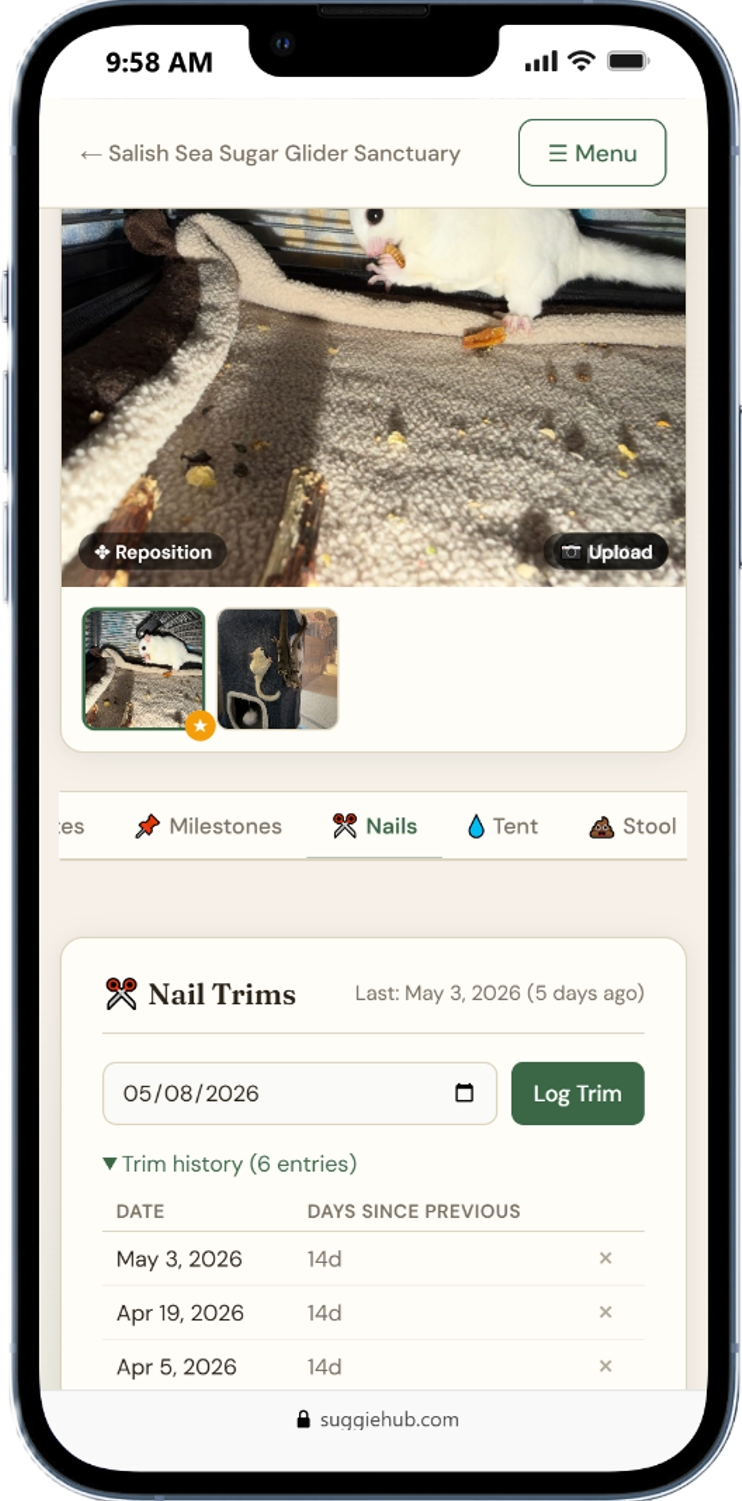
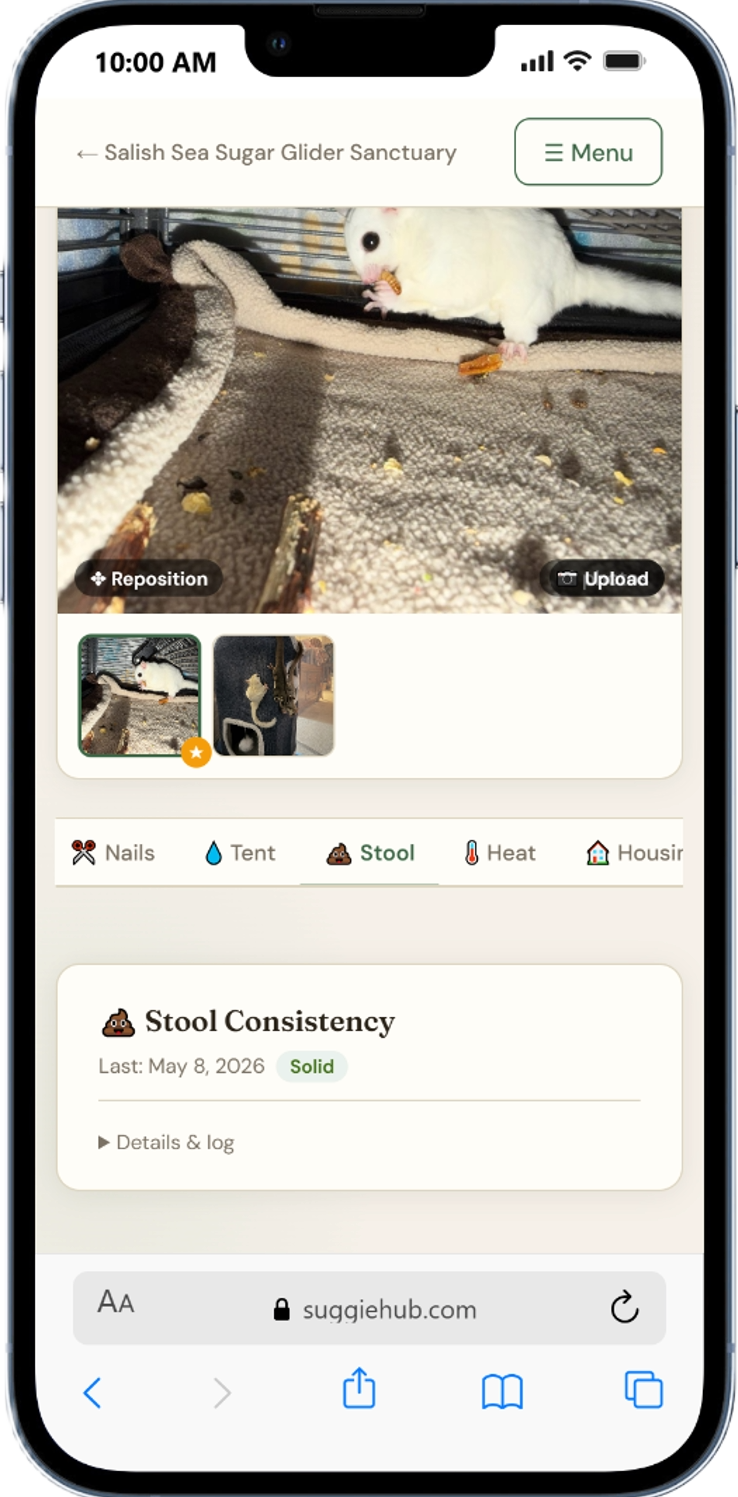
Sugar glider nail trim tracker showing per-glider logs and days since last trim Sugar glider stool consistency tracker with log history

What it does

Health tracking in SuggieHub covers the recurring care tasks that don't fit neatly into weight logs or vet notes — the things you do every few weeks that matter more than they seem. Together, these logs build a baseline for each glider that makes it much easier to spot when something is off.

Nail trims are the most frequently needed. Glider nails grow fast, and overgrown nails are a real injury risk — they get caught in fleece, in cage bars, in bonding pouches, and in anything else fabric-adjacent. A nail that tears out causes pain, bleeding, and potential infection. SuggieHub lets you log nail trims per glider with one tap, or log a whole cage at once if you're trimming all your gliders in one sitting. Every trim is timestamped and stored, so you can see at a glance how many days it's been for any individual glider.

Stool consistency monitoring is one of the most useful early-warning tools a glider owner can have. Changes in stool — color, consistency, frequency — can signal dietary problems, stress, parasites, or illness. Tracking it means you have something to report to your vet beyond "I thought something seemed off." A week of loose stools logged with dates is a much more useful piece of information than a vague recollection.

Tent test tracking records results from bonding tent sessions — a key tool for taming and socializing gliders. Logging outcomes over time shows you whether a glider's comfort level is improving, plateauing, or regressing, which matters both for bonding progress and for detecting behavioral changes that might have a health cause. Heat cycle logs round out the picture for owners managing pairs or colonies, helping track breeding patterns and anticipate behavior changes.

Key capabilities

Four distinct health tracking tools, all connected to each glider's complete profile.

💅

Per-glider nail trim log

Log a nail trim for any individual glider with one tap. Every trim is timestamped and stored in full history.

🏠

Bulk cage nail trim logging

Trimming the whole cage at once? Log it all in a single action. Each glider in the cage gets their own entry.

📋

Full trim history

Every nail trim ever logged is stored — date, time, and which glider. Pull the history anytime you need it.

⏱️

Days-since-last-trim tracking

Each glider's profile shows exactly how many days since their last nail trim so you always know who's due.

🔍

Stool consistency monitoring

Log stool observations per glider with notes. Build a running record that gives your vet real data to work with.

Tent test result logging

Record bonding tent session outcomes per glider over time. Track taming progress and catch behavioral changes.

🌡️

Heat cycle tracking

Log heat cycles for gliders in pairs or colonies. Track breeding patterns and anticipate behavior shifts.

📈

Health pattern over time

All logs connect to each glider's full profile, giving you a longitudinal view of their health across every tracked dimension.

Why it matters for your glider

Sugar gliders are prey animals. Hiding illness and discomfort is a survival instinct — by the time a glider shows obvious signs that something is wrong, the problem is often already well advanced. The value of health tracking is that it gives you a baseline. When you have a record of what "normal" looks like for a specific glider, deviations from that baseline become visible much earlier than they would if you were relying on memory and instinct alone.

Nail trims are a good example of something that seems cosmetic until it isn't. A glider whose nails are overlong can get a nail caught in fleece, in cage wire, or in your shirt sleeve, and tear it out at the quick. That's an emergency vet visit. Logging trims and knowing how many days it's been for each glider is the difference between catching it at 3.5 weeks and catching it at 7 weeks because life got busy.

Stool logs serve a different purpose — they're diagnostic breadcrumbs. If a glider develops a parasite load, a dietary imbalance, or stress-related digestive issues, the stool will often show it before anything else does. Having a dated record of what you observed and when means your vet can correlate it with other events (a new cage mate, a diet change, an environmental stress) and reach a diagnosis faster. The log you kept on a Tuesday night in January might be the most useful thing you bring to a March vet appointment.

Colony behavior is another health signal that's easy to miss without a record. "Balling up" — where gliders in a colony pile together and fight rather than sleep peacefully — is a serious warning sign. It can mean the group dynamic is breaking down, but it can also mean a sick glider is being bullied by healthy ones. Gliders instinctively isolate or mob a colony member that is behaving differently due to illness. If you're logging behavior observations alongside your other health data, a sudden change in colony dynamics has context — and your vet has a timeline.

Seasonal changes matter too. Gliders kept in rooms that drop below 70°F in winter are at real risk for torpor — a dangerous, involuntary sleep state — and respiratory infections. Health logs that span seasons help you catch whether recurring issues have a temperature pattern, which is information that's easy to overlook when you're only thinking about what's happening right now.

Nail health & injury prevention

Overgrown glider nails catch and tear — on fleece, cage wire, and fabric. Consistent trim tracking means you always know exactly who is due, not who you think might be overdue.

Stool as a health indicator

Changes in stool consistency, color, or frequency can signal dietary issues, parasites, or illness before other symptoms appear. Dated records give your vet something concrete to work with.

Colony behavior as a health signal

Balling up, fighting, or sudden changes in group dynamics can mean a glider is sick and being bullied. Behavioral logs give you a timeline to share with your vet — not just a vague sense that "something changed."

Seasonal health patterns

Gliders are sensitive to temperature drops. Logs that span seasons help you spot whether recurring health issues correlate with colder months — a pattern that's hard to see without a record.
See it in action

Nail trim logs and stool tracking, both tied directly to each glider's profile and full health history.

Nail trim tracker per-glider view in SuggieHub showing trim history and days since last trim Stool consistency monitoring log in SuggieHub with dated observation entries

Frequently asked questions

What's the right nail trim frequency for sugar gliders?
Most experienced owners trim every 3-4 weeks, though it varies by individual glider — some grow faster than others. The days-since-trim counter on each glider's profile makes it easy to check without having to remember when you last did it. If a glider's nails are starting to curl or catching on fabric, that's the real signal regardless of the calendar.
Why track stool consistency?
Stool is one of the first things to change when something is wrong with a glider's health. Loose stools can indicate dietary imbalance, stress, parasites, or infection. Hard or infrequent stools can signal dehydration or digestive issues. A log with dates gives your vet concrete information rather than a vague sense that "something seemed off a few weeks ago."
What is a tent test?
A tent test (also called a bonding tent session) is when you sit inside a small tent or covered space with your glider and let them explore you at their own pace. It's a common and effective taming technique. Logging results over time — whether the glider was skittish, curious, accepting treats, or comfortable enough to climb on you — shows you the arc of their bonding progress.
Can I log nail trims for a whole cage at once?
Yes. If you trim all the gliders in a cage during the same session, you can log it as a bulk action and every glider in that cage gets an individual entry. Each glider's history and days-since counter update independently from that single log action.
How does this connect to the glider's profile?
All health tracking logs — nail trims, stool observations, tent tests, and heat cycles — are accessible from the individual glider's profile page alongside their weight history, vet notes, medications, and milestones. Everything is in one place, so the full picture is never more than a tap away.

Free for owners, rescues, and breeders.

No credit card. No app to download. Every health tracking feature is included in your free SuggieHub journal — nail trims, stool logs, tent tests, and everything else.

Create your free journal
Takes about 60 seconds to set up.