Sugar glider cages get dirty in layers — fleece on one schedule, water bottles on another, food dishes on a third. SuggieHub's cleaning day tracker gives every task its own recurring schedule and surfaces everything overdue right on your journal home. You'll always know what needs attention before your nose does.
Sugar glider cage hygiene is not optional — it's a direct health input. Ammonia from urine builds up in fleece liners faster than you'd expect, especially with multiple gliders sharing a space. Bacteria accumulate in water bottle nozzles. Food dishes harbor mold. And unlike cats or dogs, gliders don't tell you when their environment is making them uncomfortable. They just get stressed, or sick, and you figure it out later.
The cleaning day tracker in SuggieHub lets you set up tasks per cage — each with its own name, description, and recurring interval in days. You set it once. After that, the system tracks when each task was last completed and computes whether it's due or overdue. Tasks past their interval are highlighted in red, with the date they were last done shown right underneath so you can see at a glance exactly how far past due they are.
Different tasks need different frequencies. Fleece liners might need swapping every 3-5 days. Water bottles should be cleaned every day or two. Food dishes after each feeding. Cage covers and large fabric items might be every week or two. Toy rotation might be monthly. You can set all of these independently, per cage — so a colony of five gliders across three cages doesn't become one giant, confusing checklist.
When any task goes overdue, a banner appears directly on your journal home page telling you exactly how many cages need attention. No digging through menus, no guessing, no sticky notes on the fridge that fall behind the scale. The alert is there the moment you open your journal.
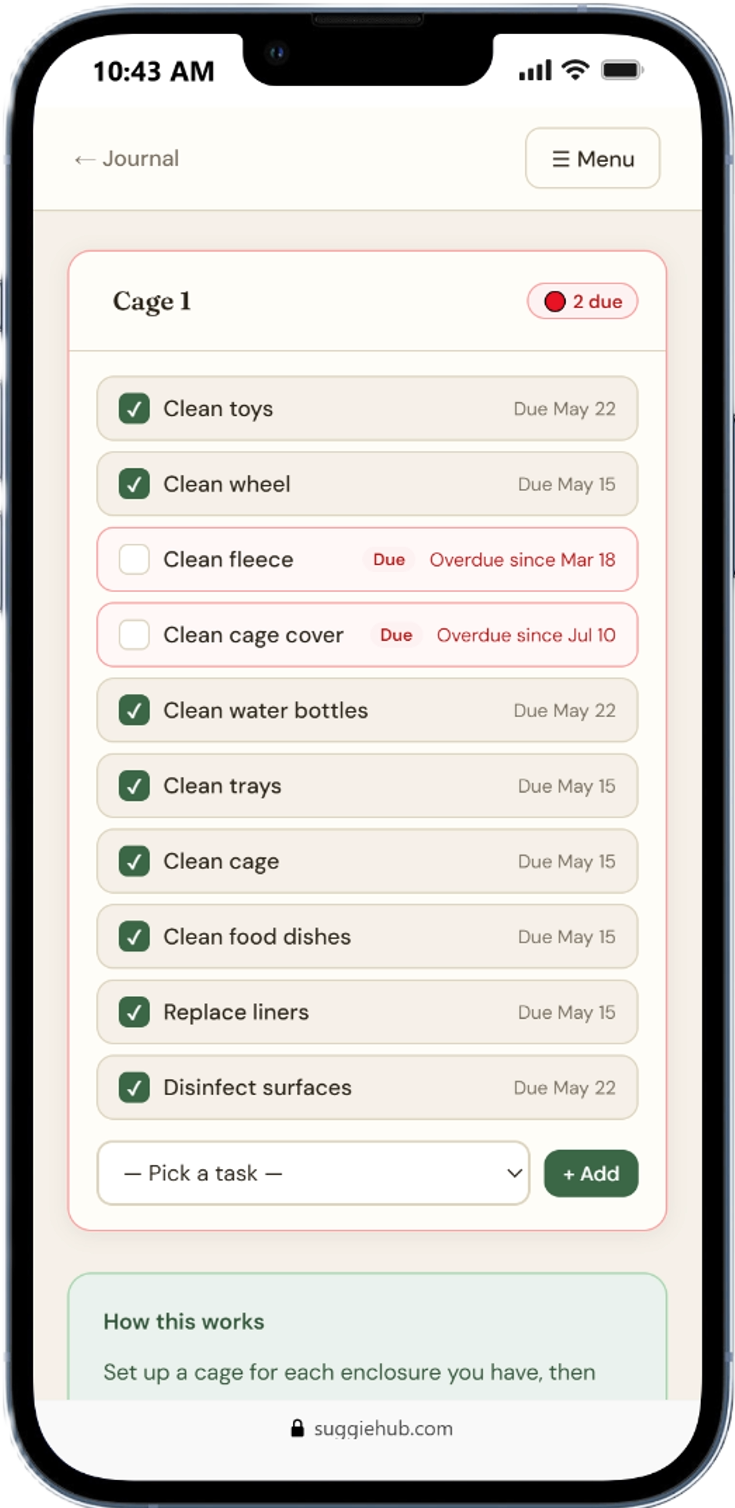
Everything you need to stay on top of cage hygiene, without keeping it in your head.
Each cage in your journal gets its own independent list of cleaning tasks. Multiple cages, multiple schedules, fully separate.
Name tasks whatever makes sense to you — "Scrub water bottle nozzle," "Swap fleece liner," "Wipe down cage bars," anything.
Set a frequency in days for each task. The system tracks when it was last done and counts forward automatically.
Any task past its due interval turns red so it's immediately obvious what needs to happen today — no scanning required.
Each task shows the exact date it was last marked complete, so you know not just that it's overdue but how overdue.
When any cage has overdue tasks, a banner at the top of your journal home tells you exactly how many cages need attention.
Add as many tasks as your cage routine requires — there's no limit. Build a full cleaning checklist for each cage.
Mark any task done with a single tap. The date resets and the countdown starts fresh from that moment.
Sugar gliders are sensitive to their environment in ways that don't always show up as obvious symptoms. Ammonia from waste builds up in fleece faster than you can smell it — and at concentrations that irritate a glider's respiratory tract long before you notice anything is off. A glider living in a cage with dirty fleece isn't going to crab at you about it. They'll just be stressed, or develop respiratory issues, or lose appetite, and you'll be at the vet trying to figure out what changed.
Water bottle hygiene is a smaller but consistent risk. Nozzles accumulate biofilm quickly, especially in warm rooms. If you've ever looked at a water bottle you thought was clean and found slime inside the tube, you already know. A task that reminds you to scrub it every two days takes 90 seconds and removes an ongoing health variable from the equation entirely.
The value of a cleaning tracker isn't that you don't know your gliders need clean cages — of course you do. It's that life happens. You travel. You get busy. One week blurs into the next and the fleece that was supposed to be changed on Thursday gets changed on the following Monday instead, and it happens three times in a row, and now there's a pattern. Having a system that shows you the date and the red color doesn't make you a better person. It just removes the cognitive load so your good intentions actually happen on schedule.
Urine-soaked fleece releases ammonia that irritates glider airways. Regular liner swaps — tracked and flagged when overdue — directly reduce this risk.
Water bottle biofilm and food dish residue harbor bacteria that can cause digestive and immune issues. Consistent cleaning schedules prevent buildup.
The cleaning day view shows all your cages, their tasks, and exactly what's overdue — at a glance.
No credit card. No app to download. Just open your browser and start tracking. Every feature — including the cleaning day tracker — is included at no cost, forever.
Create your free journal